




Have you ever wondered about the roots of marketing and how it all began? Suppose you’re a business professional or entrepreneur in the digital marketing industry. In that case, there’s no doubt that you often grapple with the rapidly changing marketing landscape and the need to stay updated with current trends. It’s no simple feat, and sometimes, understanding where it all began, the true beginning of marketing, can provide insightful context and sharpen your approach.
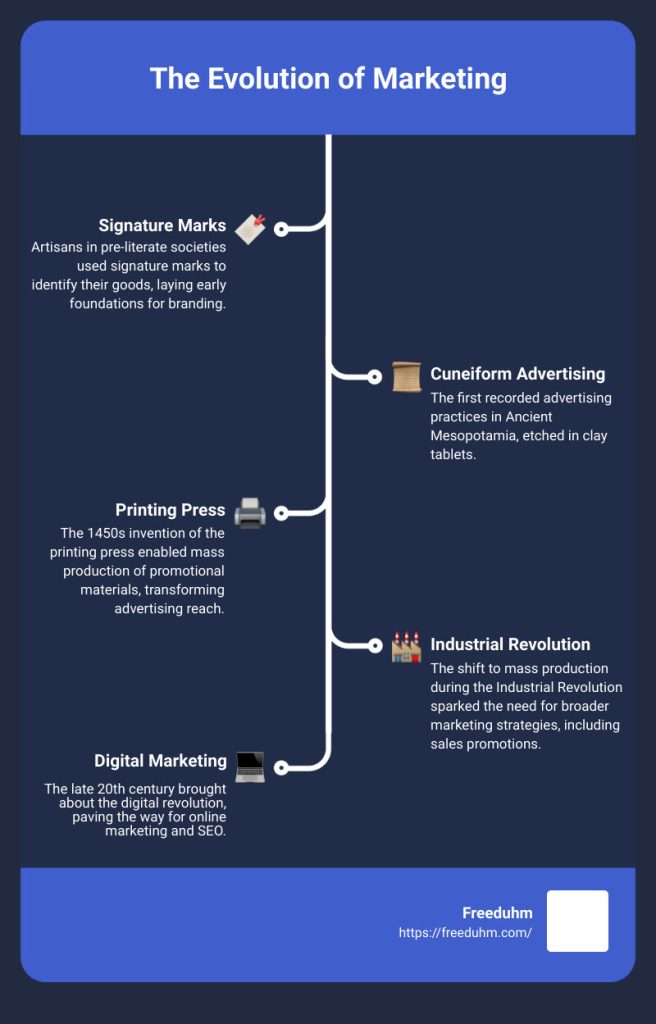
The roots of marketing extend far into human history. In its simplest form, marketing was a basic exchange process between two parties, namely, the buyer and the seller. The business landscape, however, has drastically changed over time. It evolved from signature marks by artisans to the first documented cuneiform writings in Ancient Mesopotamia, to the mass production and standardization methods birthed by the Industrial Revolution, and finally, to the intricacies of digital marketing as we know it today.
In a nutshell, here are some key milestones in the journey of marketing throughout history:
- Ancient times (Pre-Literate Societies): Artisans used signature marks to distinguish their goods.
- Ancient Mesopotamia: The first recorded instances of advertising practices.
- 1450s: The invention of the printing press revolutionized advertising with the proliferation of print content.
- Industrial Revolution: Transition from artisanal production to mass production and standardization, birth of door-to-door sales and promotions.
- 1920s: Radio and Television became mainstream platforms for advertisements.
- 1950s: The concept of Marketing Mix was introduced.
- Late 20th Century: The emergence and rapid advancement of digital and online marketing technologies.
And that’s it! A brief look back at the evolution up until the beginning of marketing. Through a deeper exploration of these different stages, we at Freeduhm aim to provide a comprehensive understanding of marketing roots, shape your knowledge, and navigate modern marketing tactics and strategies.

The Earliest Forms Of Marketing: From Signature Marks To Cuneiform Writings
The Role Of Artisans In Pre-Literate Societies
The inception of marketing can be traced back to prehistoric times, even before the invention of written language. Artisans in these societies created unique goods, like jewelry and figurines, artistic expressions, and early marketing tools. Their craftsmanship distinguished their offerings from others, and their creations were early specialty goods traded around the globe.
These early forms of marketing were not purposeful strategies but an innate human practice of showcasing creativity and skill. The artifacts discovered in Ice Age caves throughout Europe testify that marketing practices have existed for at least 40,000 years! This claim is backed by historians like Eric H. Shaw, who argue that marketing practices have been around since the dawn of human creativity and commerce.
The First Recorded Advertising Practices In Ancient Mesopotamia
The first tangible evidence of marketing practice coincides with the advent of written language. Ancient Mesopotamia, an area that is now modern-day Iraq, is home to the first recorded instance of advertising. Clay tablets dating back to 1750 BC included messages similar to modern-day customer complaints. For example, one tablet records a complaint from a customer named Nanni to a merchant named Ea-nasir about receiving the wrong grade of copper ore.
These tablets highlight the existence of trade and commerce and the importance of customer satisfaction, which remains a cornerstone of modern marketing. Even in these early societies, the role of communication in managing customer relationships was evident.
As we delve deeper into the beginning of marketing, we realize that many practices and principles we observe today are rooted in these early societies. The journey from artisans’ markings to cuneiform writings to the digital marketing practices of today is fascinating, underscoring the ever-evolving nature of marketing.
Stay with us at Freeduhm as we explore the marketing history, aiming to equip you with a well-rounded understanding of the field. In our next section, we’ll discuss the impact of the printing press on marketing, marking another significant milestone.
The Impact Of The Printing Press On Marketing
The beginning of marketing took a significant turn with the invention of the printing press in the 1400s. This device revolutionized how businesses communicated with their potential customers, laying the groundwork for a consumer-focused culture and modern marketing activities.
The Birth Of Print Advertising In The 1450s
The power of print media didn’t go unnoticed. Within a decade of the introduction of the printing press, the first recorded print advertisement was created in the 1450s. This new medium provided businesses a quick and cost-effective way to reach a vast audience. The use of print for advertising purposes soon skyrocketed, paving the way for more sophisticated advertisements.
The first magazine ad, for instance, was featured in Benjamin Franklin’s General Magazine in 1742, illustrating the evolving nature of print advertising. The subsequent introduction of direct mail advertisement in 1862 further expanded the reach of businesses, enabling them to connect directly with potential customers at their homes.
The Emergence Of Magazines And Billboards In The 18th And 19th Centuries
As we moved into the 18th and 19th centuries, the Industrial Revolution brought about significant changes in production and distribution, leading to the growth of businesses and a more pressing need for marketing. Companies started using newspapers and magazines to advertise, expanding their reach and audience.
Additionally, the late 19th century saw the introduction of lithography, making it possible to create colorful and visually appealing posters. This led to the rise of billboard advertising, with large signs capturing the attention of passersby in urban areas and creating brand awareness.
These advancements in print advertising laid the foundation for the tactics and strategies we at Freeduhm and other marketers use today.
The following section will examine how marketing strategies evolved during the Industrial Revolution, further shaping how we understand and practice marketing.
The Evolution Of Marketing During The Industrial Revolution
The Industrial Revolution, from the 1860s to the 1920s, was a transformative period for technology, production, and marketing. This era marked a shift in the fabric of commerce as new technologies facilitated mass production and heightened market competition.
The Shift From Artisanal Production To Mass Production
Before the Industrial Revolution, goods were primarily artisanal – handmade, unique, and produced in limited quantities. However, the advent of new technologies during the Industrial Revolution made mass production possible for the first time. Factories could now generate goods in higher amounts and at a faster pace. This technological breakthrough had a profound impact on marketing.
Due to the increased production capacities, businesses could now reach a wider audience with their products. The mass production also meant lower prices, making products more affordable for consumers. This era was a pivotal time in the beginning of marketing because it laid the foundations for modern mass-market techniques.
Companies like Ford were among the first to capitalize on the benefits of the industrial revolution. They introduced assembly lines that significantly streamlined the production of their Model T automobiles. This efficiency allowed them to lower the selling prices of their cars, making them more accessible to the average consumer.
The Rise Of Sales Promotions And Door-To-Door Sales
The Industrial Revolution also ushered in the Sales Era, a period from the 1920s to 1940s characterized by heightened competition. New companies emerged, aiming to snatch market shares from established businesses. The main goal during this era was straightforward – sell as many units as possible.
During this Sales Era, customer experience and product quality often took a back seat. Companies used eye-catching sales promotions, radio commercials, and door-to-door sales to entice customers. Proctor and Gamble, for instance, turned to radio broadcasts to communicate with their target audience when they noticed a slump in orders and a pile-up of inventory in 1929. These ads became a sensation, crucial to the company’s survival during the Great Depression.
The Industrial Revolution was a pivotal period in the history and evolution of marketing. It saw a shift from artisanal production to mass production and introduced new marketing techniques like sales promotions and door-to-door sales. The marketing strategies that emerged during this period continue to shape our understanding and practice of marketing at Freeduhm. In the next section, we’ll explore how the advent of radio and television advertising further transformed marketing.
The Advent Of Radio And Television Advertising
Marketing took a massive leap in the 1920s with the advent of radio and television advertising. This period marked a significant transformation in the beginning of marketing, providing brands with new platforms to reach larger audiences and further engage with their customers.
The Transformation Of Marketing In The 1920s
The first paid radio ad hit the airwaves in 1922 when AT&T paid $100 for a 10-minute advertisement to promote Long Island apartments. This innovative marketing approach marked the start of a new era, with nearly 90 percent of all U.S. radio stations broadcasting ads by the 1930s (source voices.com).
This new era of marketing didn’t stop at radio. By 1941, radio advertisements had evolved into TV ads. The first TV commercial aired on July 1, 1941, for Bulova Watch Co. Compared to today’s average airing slot cost of $8000, the $9 spent by Bulova was quite a bargain! Nevertheless, their investment marked a significant milestone in the development of marketing.
The Influence Of Brands Like Coca-Cola and Marlboro
Brands quickly seized the opportunities radio and TV advertising provided to reach larger audiences. For example, Coca-Cola’s “Share a Coke” campaign is a notable example of successful outbound marketing. The campaign cleverly replaced the iconic Coca-Cola logo on bottles with famous names, encouraging customers to share bottles with friends and family. This innovative marketing approach increased brand engagement and boosted sales.
Another brand that leveraged the power of TV advertising was Marlboro. They created a memorable campaign featuring the Marlboro Man, a rugged cowboy that became synonymous with the brand. This campaign significantly boosted Marlboro’s sales and solidified its position in the market.
The advent of radio and TV advertising was a game-changer. The ability to reach a larger audience and the creative possibilities these new platforms offered paved the way for today’s sophisticated, multi-channel marketing strategies.
The Emergence Of The Marketing Mix And Performance Measurement
Just as the advent of radio and television transformed advertising, the marketing mix concept and the development of marketing performance measurement revolutionized how businesses approached marketing.
The Introduction Of The Marketing Mix Concept In The 1950s
In the increasingly saturated marketing landscape of the 1950s, it became clear that traditional advertising methods were insufficient. The marketing mix concept was introduced, offering a structured marketing approach that was more nuanced than the earlier “spray and pray” tactics.
The marketing mix was first coined by Neil Borden in 1952 and identified four key ingredients for marketing success: product, price, promotion, and place. This concept, often called the “four Ps,” emphasized understanding consumer demand, pricing strategies, promotional tactics, and distribution channels. This approach allowed marketers to align their strategies more effectively with consumer needs, thereby improving the success of their marketing campaigns.
The Development Of Marketing Performance Measurement And Mix Modeling
The marketing mix concept laid the foundation for developing marketing performance measurement and mix modeling. Initially, the marketing mix was confined to print, broadcast, and out-of-home advertising, allowing marketers to collect long-term aggregate data reflecting marketing strategies’ impact on sales.
By analyzing this data in the context of the four Ps of marketing, marketers could refine their strategies to ensure the right message was delivered to the right consumer at the right time. This approach eventually evolved into what we now call marketing mix modeling (MMM), the first modern marketing measurement strategy.
Understanding the beginning of marketing and the evolution of concepts like the marketing mix and performance measurement is key to appreciating the complexity and sophistication of modern marketing. At Freeduhm, we believe that by learning from the past, we can better navigate the future, harnessing the power of historical insights to drive innovation and success in today’s dynamic digital landscape.
The Digital Revolution And The Rise Of Online Marketing
The advent of digital technology marked a new dawn in the beginning of marketing. This era ushered in tools and platforms that completely transformed how businesses connect with their audiences. This section of our guide will delve into the significant shifts that occurred with the beginning of marketing in the digital age.
The Influence Of Personal Computers, Smartphones, And Social Media On Marketing
The proliferation of personal computers in the early 1990s was a significant milestone in the evolution of digital marketing. Before PCs, marketing was primarily analog, relying heavily on print, television, and radio. The introduction of PCs opened up a world of new possibilities and reshaped the marketing landscape.
The growth and popularity of the internet sparked innovative digital marketing ideas. For instance, the million-dollar homepage created in 2005 sold ad space on a website with one million pixels for $1 per pixel. But that was just the beginning.
Fast forward to a decade later, smartphones made a grand entry, changing how we live, work, and play and how businesses market their products. According to a 2015 survey, 82% of users turned to their phones when deciding whether to buy a specific product while standing in a store. This shift in consumer behavior increased businesses’ visibility as consumers were exposed to more online ads and branded content.
The cherry on the cake was the emergence of social media platforms like Facebook, X (Formerly Twitter), and Instagram. These platforms provided a way for brands to connect with consumers, build relationships, and target them with ads for a relatively low cost. Brands like Dollar Shave Club leveraged social media marketing to convert first-time buyers into long-lasting customers.
The Emergence Of E-commerce Promotions And Search Engine Optimization
As online shopping grew in popularity, so did e-commerce promotions. Bristol-Myers Squibb was the first company to have an online marketing campaign to promote their Excedrin product. The campaign succeeded, adding thousands of names to their customer list.
Another crucial aspect of digital marketing that emerged during this era was Search Engine Optimization (SEO). SEO involves optimizing website content to rank high on search engine pages. This strategy is crucial for attracting organic traffic and increasing visibility. To learn more about SEO techniques, check out our SEO guide.
The Role Of Blogs In Information Dissemination, Customer Relationships, And Brand Awareness
Initially developed as online diaries, blogs became integral to marketing in the late 1990s. Today, blogs are part of most content marketing campaigns, serving multiple purposes. They provide information, build customer relationships, generate sales leads, increase brand awareness, and garner customer feedback.
At Freeduhm, we recognize the power of blogs in developing internal and external networks for building brand and company awareness. That’s why we continuously work on providing you with valuable and informative content through our comprehensive digital marketing resources.
The rise of digital marketing brought about significant changes in the marketing landscape. It’s essential to keep up with these changes and leverage the opportunities they present. Stay tuned as we explore the future of marketing in the following section of our guide.
Personalization And New Technologies
As we delve into the future of marketing, we’ll discuss the shift from broad campaigns to authentic relationships, the importance of customer touchpoints and psychological foundations in marketing, and the emergence of new social media platforms and their impact on marketing.
The Shift From Broad Campaigns To Authentic Relationships And Niche Targeting
Marketing has evolved over the years, moving from focusing on broad, impersonal campaigns to a more personalized, targeted approach. This shift is primarily due to the growing importance of building authentic customer relationships.
In the future of marketing, personalization will become even more crucial. With advancements in artificial intelligence and machine learning, we can deliver hyper-personalized content, products, and experiences to individual customers at scale. This approach fosters more profound consumer connections, increasing engagement and loyalty.
Niche targeting also plays a critical role in modern marketing. Instead of trying to appeal to everyone, successful marketers identify and target a specific audience segment. This approach allows us to create more tailored campaigns that resonate with our audience, leading to increased effectiveness and ROI.
The Importance Of Customer Touchpoints And Psychological Foundations In Marketing
Understanding customer touchpoints and the psychological foundations of consumer behavior is vital for effective marketing. In the future, marketing strategies will need to ensure consistent interactions across various online and offline touchpoints. This consistency is essential for delivering cohesive and engaging brand experiences.
Understanding the psychological foundations of consumer behavior can help us create more compelling marketing campaigns. By understanding how customers think and make decisions, we can tailor our marketing efforts to influence their behavior and drive desired outcomes.
The Emergence Of New Social Media Platforms And Their Impact On Marketing
Social media has revolutionized the marketing landscape, providing new platforms and opportunities for businesses to connect with their audiences. New social media platforms with unique features and audience demographics continue to emerge.
These platforms offer innovative ways to engage with customers, from interactive content and gamification to influencer marketing and community building. For instance, leveraging influencer marketing on platforms like Instagram can help us reach niche audiences and build brand advocacy.
In the future, we’ll need to stay ahead of social media trends and adapt our strategies to leverage each platform’s unique opportunities. This approach will help us to continue engaging our audience effectively and drive success in our marketing efforts.
In conclusion, the future of marketing holds exciting possibilities and challenges. By embracing emerging technologies, prioritizing personalization, and understanding the importance of customer touchpoints and psychological foundations, we can navigate these challenges and harness future opportunities.
The Continuous Evolution Of Marketing And Its Impact On Business And Society
The marketing history is a fascinating tale of innovation, adaptation, and evolution. From using signature marks in ancient Mesopotamia to today’s sophisticated digital marketing strategies, the core objective has remained: to connect with the audience and persuade them to choose a particular product or service. The beginning of marketing demonstrates the ingenuity of humans in creating effective ways to communicate and influence.
Throughout history, marketing has continuously adapted to the changing business environment, leveraging new technologies, understanding consumer behavior, and experimenting with innovative strategies. This continuous evolution has driven business success, enhanced the competitive edge, and fostered economic growth. For instance, the advent of the printing press in the 1450s revolutionized marketing by paving the way for mass communication. Similarly, the rise of radio and television advertising in the 20th century transformed the marketing landscape, enabling brands to reach a global audience.
However, the evolution of marketing is not just about technology; it’s also about understanding human psychology and building relationships. The shift from broad campaigns to personalized marketing strategies reflects this understanding. By creating authentic relationships and targeting niche markets, businesses can better meet individual customer needs, increasing customer satisfaction and loyalty.
The growth of online marketing, driven by the proliferation of personal computers, smartphones, and social media, has further transformed marketing practices. These digital platforms have made it possible to target specific demographics, track customer behavior, and measure marketing performance with unprecedented precision. For example, innovations like search engine optimization and e-commerce promotions have opened up new avenues for businesses to reach and engage customers.
The marketing landscape will continue to evolve, driven by emerging technologies and changing consumer preferences. As marketers, we must continue to learn, adapt, and innovate to stay ahead of the curve. This requires a deep understanding of marketing principles and a willingness to experiment with new strategies and techniques.
At Freeduhm, we are committed to helping you navigate the dynamic marketing world. We offer comprehensive resources to help you stay updated with the latest trends, develop your digital literacy, and enhance your marketing skills. Whether you’re a seasoned professional or an aspiring marketer, we are here to support your journey.
As we conclude this guide on the beginning of marketing, we invite you to explore other areas of marketing on our website. Learn more about the emerging trends in marketing, delve into the intricacies of CPA marketing, or discover how you can leverage data analytics in your marketing strategy.
Marketing is a dynamic field that thrives on innovation and continuous learning. Embrace the journey, and let’s shape the future of marketing together.


