


The 2008 financial crisis shook the global economy to its core, with Collateralized Debt Obligations (CDOs). Let’s examine how these complex financial instruments contributed to the economic meltdown, drawing on insights from industry pros. Readers will understand how CDOs transformed risky loans into seemingly safe investments, ultimately amplifying the subprime mortgage crisis.
CDOs: Complex Financial Instruments Explained
CDOs are financial instruments that pool various assets, such as mortgages, auto loans, and credit cards, into tranches and then position them to be sold to investors. Each tranche has a different risk-return profile, with the most senior and least risky tranches receiving payments ahead of the more junior and riskier tranches, which bear losses first in case of defaults.
The Problem
A real estate boom in the early 2000s saw a rapid increase in mortgage lending, with a considerable share of subprime mortgages–home loans extended to borrowers with tarnished credit histories. These risky loans were bundled into mortgage-backed securities (MBS), which were often repackaged into CDOs. The problem? The rating agencies rated these CDOs highly regarding credit, even though subprime loans largely backed them. Financial institutions, hedge funds, and even pension funds poured money into these, considering them safe and profitable.
Here’s how CDOs aided the 2008 crisis:
- Risk Mispricing: Investors underestimated CDO risk, with credit-rating agencies over-optimistically rating them. Tranches filled with subprime mortgages would be AAA-rated, thus triggering widespread purchases.
- Lack of Transparency: The complexity of CDOs meant that investors could not understand what they were buying, and many could not gauge their exposure to risky subprime loans.
- Excessive Leverage: Banks borrowed to buy or create more CDOs, thereby increasing risk in the financial system.
- Default Cascade: As housing prices depreciated and borrowers defaulted, the assets underlying the CDOs, including the good ones, started to lose value. This also resulted in enormous losses for investors, including major financial institutions such as Lehman Brothers and AIG.
- Weakened Credit Markets: Uncertainty about who held the toxic CDOs caused banks to stop lending to each other, leading to a global credit freeze and economic downturn.
The CDO market collapse was a significant trigger for the financial crisis. This culminated in:
- Major bank failures
- Trillions of dollars in losses
- Government bailouts of financial institutions
- Wide-ranging financial reforms, such as the Dodd-Frank Act, are needed to improve transparency and reduce systemic risk regarding derivatives and structured finance products.

Loretta Kilday, DebtCC Spokesperson, Debt Consolidation Care
Structured Products Amplify Subprime Mortgage Crisis
Collateralized Debt Obligations (CDOs) are a structured financial product that pools together cash-flow-generating assets and repackages this asset pool into discrete tranches that can be sold to investors. These tranches vary in risk and potential return, with higher risks associated with higher returns. Initially, CDOs were hailed for their ability to diversify risk and enhance returns; however, they became increasingly complex and opaque over time.
The role of CDOs in the 2008 financial crisis was significant and multifaceted. Many CDOs heavily incorporated subprime mortgage loans, which were issued to borrowers with poor credit histories and a high risk of default. As housing prices began to decline and mortgage delinquencies rose, the value of these CDOs plummeted, leading to substantial losses for investors.
Financial institutions worldwide that heavily invested in these products or were insuring them faced massive financial distress. This cascade of events was pivotal in triggering the global financial meltdown of 2008. The crisis highlighted the dangers of excessive complexity and lack of transparency in financial instruments, reminding the industry and regulators of the need for greater scrutiny and clearer standards.

Alex Cornici, Writer, Insuranks
CDOs Disguise Risky Loans As Safe Investments
CDOs (Collateralized Debt Obligations) are financial products that bundle different kinds of debt, like home loans, credit card debt, or business loans, into one large package. This package is then divided into slices called tranches, based on risk. Some slices are considered “safe” with lower returns, while others are deemed “risky” with higher returns.
Before the 2008 crisis, banks began incorporating subprime mortgages into these CDOs—home loans given to individuals with poor credit who were more likely to default. However, this practice became dangerous for several reasons:
- Toxic Loans In Disguise: Many risky mortgages were bundled into CDOs and then rated AAA (the safest rating) by credit agencies, even though they were far from secure.
- Lack Of Understanding: These products were highly complex. Most investors, and even the banks selling them, did not fully comprehend what was inside or how risky they were.
- Widespread Adoption: Major banks, hedge funds, pension funds—virtually everyone was purchasing CDOs, believing they were secure investments. In reality, they were sitting on ticking time bombs.
- Bubble Burst: When people began defaulting on their mortgages, the value of those CDOs plummeted rapidly. Banks lost billions, trust in the financial system collapsed, and credit froze, causing the 2008 financial meltdown.
In summary, CDOs took bad loans, wrapped them in an attractive package, and sold them as good investments. When the truth was revealed, it was too late. The result was a global crisis that adversely affected millions of people.

MD Tanjib, Marketing Consultant, Forex Prop Firms
AAA To Toxic: How Credit Ratings Masked The Risk?
I can tell you firsthand that the role of credit rating agencies (CRAs) in the 2008 financial crisis cannot be overstated. These agencies—primarily Moody’s, Standard & Poor’s, and Fitch—assigned investment-grade ratings, often AAA, to tranches of collateralized debt obligations (CDOs) that were anything but low-risk. The problem wasn’t just in their models—the incentives, the opacity, and the blind reliance on flawed assumptions about mortgage default correlations.
Let’s break it down technically. A CDO pools together various types of debt, primarily subprime mortgage-backed securities, in this case, and slices them into tranches, each with varying levels of seniority and risk. The top tranches, considered senior, were the first to be paid and thus perceived as safest. Credit rating agencies applied models like Gaussian copula functions to simulate correlations among the underlying mortgage defaults. These models depended heavily on historical data from relatively stable housing markets—data that quickly became irrelevant once housing prices stalled and then reversed.
But here’s where the distortion kicked in: CRAs were paid by the issuers of the securities they rated. This “issuer-pays” model created an apparent conflict of interest. If a firm didn’t get the desired rating, it could simply shop around to another agency. As a result, rating agencies had a strong incentive to inflate ratings to win business. Complex, high-yielding securities that were structurally risky—some even backed by subprime or “Alt-A” loans—received AAA ratings, equating them with U.S. Treasury bonds in the eyes of many investors.
This misrepresentation had massive downstream effects. Institutional investors, including pension funds and insurance companies, were bound by regulation to invest primarily in highly rated assets. With AAA ratings stamped on what were essentially ticking time bombs, they loaded up on toxic assets without the capacity—or in some cases, the authority—to challenge those ratings.
When the mortgage defaults began piling up in 2007 and 2008, these CDOs unraveled. Tranches that were rated AAA were suddenly worth pennies on the dollar. When investors realized these ratings were built on sand, the damage was done. Instead, the system that was supposed to signal risk had amplified it.
In hindsight, the reliance on credit ratings was one of the most systemic failures in the crisis. For those of us in the industry at the time, the lesson was painfully clear: a rating is only as good as the model—and the incentives—behind it.
The Rise Of Synthetic CDOs: Betting On a Bubble
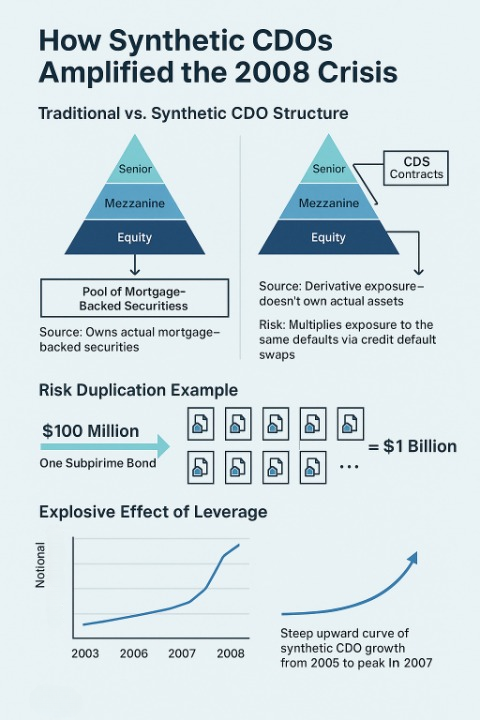
In Image: How Synthetic CDOs Amplified The 2008 Financial Crisis
Back in the mid-2000s, synthetic CDOs started gaining traction. On paper, they were an elegant innovation, designed to expose investors to credit risk without buying the actual assets. In practice, they became one of the most dangerous accelerants of the financial crisis. Unlike traditional CDOs, which bundled actual mortgage-backed securities, synthetic CDOs were composed of credit default swaps (CDS) referencing those securities. That subtle difference changed the game.
Let me explain: a synthetic CDO doesn’t own any real mortgages. Instead, it sells insurance on them—essentially betting that a referenced portfolio of mortgage bonds won’t default. If defaults spike, the synthetic CDO pays out. If not, the investor collects steady premium payments. Depending on how you look at it, the beauty or the flaw is that these synthetic instruments allowed for unlimited duplication of the same underlying risk. One subprime mortgage bond could be referenced in multiple synthetic CDOs, meaning that if it defaulted, losses would ripple across a much larger notional exposure than the actual underlying debt.
This made the system incredibly fragile. The same $100 million pool of mortgages could spawn billions in synthetic exposure through repeated CDS referencing. Because these instruments were often structured in tranches, similar to traditional CDOs, many investors believed they were insulated from significant losses—until the whole structure collapsed under the weight of correlation.
What’s more, the growth of synthetic CDOs brought in a new class of participants—those who wanted to short the housing market but couldn’t easily do so through conventional means. Hedge funds like Paulson & Co. famously worked with banks to construct synthetic CDOs composed of low-quality mortgage bonds, then took the short side of the trade by purchasing CDS protection. That meant there was always someone on the other end betting against the housing market, even as the instruments were sold to investors as safe.
I remember sitting in meetings where the structure of these deals was discussed in terms of “alignment of incentives” and “risk dispersion.” In reality, the only thing being dispersed was the illusion of safety. Synthetic CDOs amplified the size of the market, increased the opacity of the underlying risk, and created a system where multiple parties could lose money on the same default event.
When the bubble burst, the leverage embedded in the synthetic CDO market turned what could’ve been a painful downturn into a full-blown global crisis. These were not just bets on the housing market—they were meta-bets on bets, stacked like kindling around an already unstable system. And once the defaults started, there was no firewall.
In hindsight, synthetic CDOs weren’t just a symptom of the crisis—they were an accelerant. They allowed risk to balloon exponentially, detached from any physical asset, and hid that risk under layers of complexity few truly understood. If traditional CDOs were the fuse, the synthetic ones were the explosion.


