



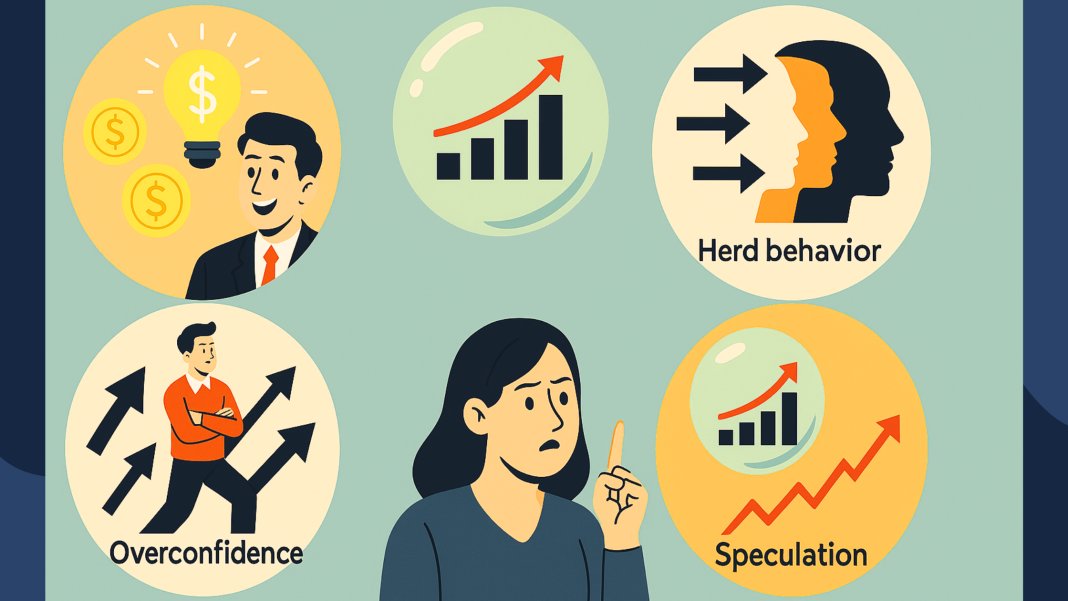
Financial bubbles have puzzled economists and investors for centuries. Let’s explore the psychological factors that contribute to their formation. Understanding the emotional, social, and cognitive elements will give you a valuable perspective on this complex economic phenomenon.
1. Overconfidence And Confirmation Bias
Equally dangerous is the role of overconfidence and the tendency to seek out information that confirms what we already believe. I’ve sat in countless strategy meetings where bullish sentiment went unchallenged simply because it felt good to consider the market would keep going up. We cherry-pick data, elevate pundits who agree with us, and dismiss red flags as noise. That’s confirmation bias at work. Combine it with overconfidence, especially during easy gains, and you get a toxic mix that blinds investors to risk. We start to believe that we’re smarter than the market, or that “this time is different,” both have preceded nearly every major bubble collapse in modern history.
2. Emotional Investing Fuels Market Bubbles
Financial bubbles develop when people become overly excited about an asset, leading to emotional purchases rather than those based on fundamental analysis. Herd mentality emerges in the market and general trends, which I have observed. The fear of being left behind drives people to join the crowd, regardless of whether the investment makes sense. Hopeful thinking, combined with excessive self-assurance and a deep-seated human anxiety about missing opportunities, fuels this phenomenon. The combination of easy money access and hype leads to rapid expansion. Then reality hits, and the bubble bursts. Staying grounded in business and investing requires ignoring distractions and focusing on things with long-term value.


Tammy Sons, Founder/CEO, TN Nursery
3. Herd Behavior: Safety Illusion In Numbers
One of the most potent forces I’ve observed is the overwhelming pull of the herd. When markets heat up, resisting the momentum becomes harder and harder. Even professionals with decades of experience can feel their confidence erode when everyone else seems to be doubling down on a winning trend. It’s that primal instinct: if everyone’s doing it, it must be right. But history has repeatedly proven that following the crowd can be the fastest path to a cliff. From tulip mania to the dot-com boom to crypto frenzies, the illusion of safety in numbers creates a feedback loop of rising prices and rising confidence, until the fundamentals no longer support the valuations and the bubble bursts.
4. Herd Mentality Drives Irrational Market Behavior
From a technical standpoint, an economic bubble is defined as a situation where asset prices coexist with the expectations of a state of euphoria due to speculative enthusiasm, patterns, and overreaction. Witness the rise in market capitalization of the “Magnificent Seven” tech stocks: a jump of over 80% from January 2023 that has led to concerns over potential over-inflation.
Psychological factors, like herd mentality and loss aversion, also contribute to bubbles. We tend to be joiners and imitators, and often assume that everyone else must know something we don’t. This causes investors to act irrationally, jumping into the market to buy before prices increase. Also, they are loss-averse and don’t want to sell an overvalued asset for fear of missing any potential upside. This creates a feedback loop where the FOMO (fear of missing out) pumps the bubble into high gear.
Focusing on what you truly invest in and not getting swept up in the market mania is key. When those moments arrive, if you are a rational investor and can avoid becoming an emotional investor, you are less likely to lose your life’s savings. You will also be less likely to adopt a mindset where inaction isn’t an option.


Rob Dillan, Founder, EVhype.com
5. The Fear Of Missing Out
There’s FOMO, fear of missing out, a subtle but powerful emotion that drives people into markets they don’t understand, at prices they can’t justify. I’ve watched intelligent, cautious investors throw out their playbooks in bull markets because they couldn’t bear to be left behind. They rationalize risky bets with the language of opportunity, not realizing they’re being swept up by emotion rather than logic. FOMO amplifies bubbles because it accelerates participation at the late stages, when risk is highest and returns are dwindling. It fuels unsustainable valuations and draws in capital, ultimately becoming the first to flee when sentiment shifts.
6. Addiction Parallels In Financial Bubble Psychology
As someone who works closely with individuals recovering from addiction, I see a striking psychological parallel between financial bubbles and the mindset of compulsive behavior. Financial bubbles often form not simply because of flawed economics, but because of emotional momentum, driven by fear, euphoria, herd mentality, and a deep human desire for security or validation.
At their core, bubbles are emotional stories people buy into. The fear of missing out (FOMO) kicks in when an asset starts climbing. People begin to invest not based on value, but on hope, and eventually on fear of being left behind. It’s the same dopamine loop I see in addiction: short-term gratification, denial of risk, and a growing dependence on external rewards to feel safe or successful.
Greed gets most of the blame, but I believe anxiety and uncertainty are also responsible. During economic or social instability, people are more susceptible to financial hype because it offers an illusion of control or escape. Once enough people believe in that illusion, it becomes self-reinforcing until reality snaps it back.
From a business owner’s perspective, I’ve learned to respect fundamentals over flash. At Ridgeline Recovery, we’ve avoided chasing unsustainable treatment models or tech trends because integrity and long-term stability matter more than short-term gains. My advice: whether investing money or building a company, don’t let emotion steer the wheel. Discipline, self-awareness, and the courage to step back when others rush in, that’s how you survive both markets and life.

Andy Danec, Owner, Ridgeline Recovery LLC
7. The Psyche Behind The Storm Of Financial Bubbles
As I step back to reflect on the psychology that fuels financial bubbles, I can’t help but recognize just how deeply human emotion, perception, and cognitive bias are entangled with market behavior. Thinking of markets as rational machines humming along on data and analysis is tempting, but that’s a dangerous oversimplification. Markets are ecosystems of people, and people are wired with complex emotional triggers.
In all my years in finance, I’ve seen that even the most seasoned investors are vulnerable to the same mental shortcuts and social pressures that drive herd behavior. Understanding the key psychological forces behind bubbles isn’t just academic; it’s a practical necessity for anyone trying to protect capital and make informed decisions in a volatile economic environment.
8. Cognitive Biases Inflate Economic Bubbles
From a psychiatric perspective, financial bubbles aren’t random moments of madness but predictable results of human psychology. A key driver is herd mentality, fueled by an intense fear of missing out (FOMO). When people see others making what looks like easy money, the instinct to follow the crowd can overrule rational thought. Being wrong with the group feels safer than being right while alone.
Compelling narratives are also essential for inflating bubbles. Humans are wired to respond more to a good story, like the “new paradigm” of a past era, than to dry data. This is amplified by overconfidence bias, where investors believe they are skilled enough to sell at the perfect moment. They convince themselves, “This time is different,” a phrase that notoriously precedes market corrections.
These cognitive traps can have devastating consequences. It’s a typical pattern for individuals caught in a bubble to describe the initial thrill as “intoxicating.” They often seek out information that confirms their decision while dismissing cautionary advice. This illustrates confirmation bias: a psychological echo chamber that reinforces beliefs until reality forces a painful correction.
Ultimately, bubbles are powered by emotion. The exhilarating rush of a rising market can lead to “emotional reasoning,” where the feeling of being smart justifies taking on more risk. This euphoria clouds judgment, making a sober assessment of risk nearly impossible. When the bubble inevitably pops, it leaves a wake of financial and emotional distress.

Ishdeep Narang, Child, Adolescent & Adult Psychiatrist | Founder, ACES Psychiatry
Final Thoughts
Ultimately, financial bubbles aren’t caused by flawed economic models or insufficient data; they’re born in the human mind. If we want to guard against them, we need to look inward just as outwardly. Recognizing and managing these psychological triggers is one of the most valuable skills an investor can develop. It’s not just about knowing when to buy or sell; it’s about understanding why we want to buy or sell in the first place. In a world where markets can be swayed by emotion as easily as earnings, mastering the psychology of bubbles isn’t just important, it’s essential.


