



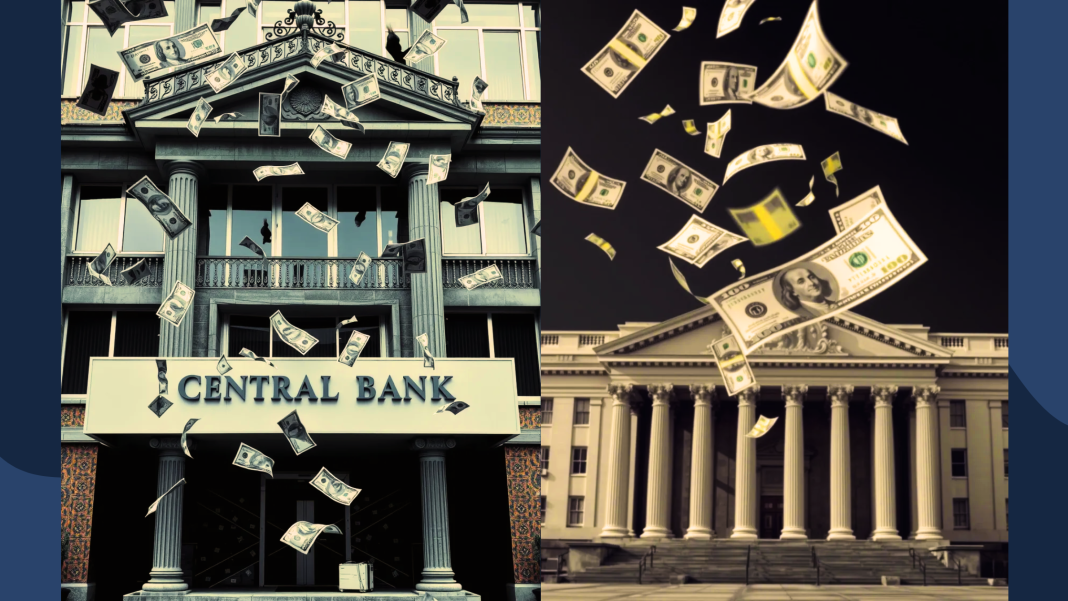
Uncover the truth about quantitative easing and its impact on economic growth through clear-cut perspectives from industry professionals. Let us strip down complex financial mechanisms to their core, assessing whether flooding the economy with money truly jump-starts activity. Anchored by expert analysis, the evaluation addresses the effectiveness of lowering interest rates and purchasing government bonds in sparking economic vitality.
Injecting Money Directly Into The Economy
Quantitative easing (QE) is when a central bank buys financial assets, such as government bonds, from the market to inject money directly into the economy. It’s like giving the economy a cash infusion to keep things moving when traditional methods, such as lowering interest rates, aren’t enough.
I remember that during my time at Deutsche Bahn while working on international market strategies, we monitored how QE in certain regions affected transport and infrastructure investments. It was fascinating to see that when liquidity increased, many countries saw a boost in funding for large-scale projects—a clear sign of QE’s ripple effect.
By buying these financial assets, central banks aim to lower borrowing costs and increase lending, ideally spurs businesses and consumers to spend more. However, there’s always a balancing act. While QE can ramp up economic growth, it can also stoke inflation if too much money chases too few goods.
At Spectup, we’ve worked with startups navigating markets impacted by QE, especially when looking for investor funding during uncertain economic climates. One client expressed concerns about inflation’s impact on operational expenses—an unintended consequence of a loose monetary policy. Still, understanding QE’s mechanics helped them position their pitch, highlighting how increased liquidity created opportunities for growth within their sector.


Niclas Schlopsna, Managing Consultant And CEO, Spectup
Making Borrowing Cheaper
Quantitative easing (QE) is when a central bank, like the Reserve Bank of Australia, increases the money supply by buying financial assets such as government bonds. The goal is to make borrowing cheaper, increase asset prices, and encourage spending and investment. It’s a tool to stimulate the economy, especially when interest rates are already low and can’t be cut further.
In terms of economic growth, QE can boost the economy by making credit more accessible, which encourages businesses to invest and consumers to spend. It’s often used during downturns to prevent a recession or to stimulate a sluggish recovery. However, it has its downsides, especially when it comes to inflation. By flooding the market with money, there’s the risk of too much money chasing too few goods, which could push prices up. So, while it can spur short-term growth, it must be carefully managed to avoid inflation getting out of hand.


Austin Rulfs, Founder / Property & Finance Specialist, Zanda Wealth
Increasing Money Supply
Quantitative easing is a monetary policy in which central banks purchase securities to increase the money supply and encourage lending and investment. In our property management accounting practice, we’ve observed QE’s direct effects on real estate markets through historically low mortgage rates, significantly impacting our clients’ refinancing strategies and acquisition models.
When the Federal Reserve implemented aggressive QE following COVID-19, we helped property managers capitalize by restructuring debt on multiple properties, reducing monthly obligations by 23% on average. However, QE also contributed to asset inflation, particularly in our clients’ housing markets. This created compression in cap rates, requiring us to develop more sophisticated cash flow analysis tools in AppFolio to ensure clients weren’t overpaying for properties based on artificially low interest rate environments.

Narine Masropian, Founder, Property Accounting Co
Lowering Long-Term Interest Rates
When I first learned about quantitative easing, it seemed like a complex buzzword, but understanding its purpose clarified it. It’s essentially a tool central banks use to boost the economy when traditional interest rate cuts aren’t enough. The bank buys bonds or other financial assets, which injects money directly into the financial system. The goal of increasing the money supply is to lower long-term interest rates, making borrowing cheaper and encouraging spending and investment.
I remember reading about its use during the 2008 financial crisis. Quantitative easing gave banks more cash to lend and helped stabilize financial markets when confidence was at an all-time low. What stood out to me was how it indirectly impacted everyone—businesses expanded due to easier credit, and people found it more affordable to take loans for homes or education. It made me realize how interconnected monetary policy is with everyday life.
However, I also learned it’s a double-edged sword. It can lead to inflation if too much money chases too few goods. Balancing growth and price stability makes monetary policy an art as much as a science.


Ben H, Founder & Owner, Dealmemo
Purchasing Government Bonds
Quantitative easing (QE) is an unconventional monetary policy used by central banks to stimulate the economy when traditional methods, like lowering interest rates, become less effective. In QE, the central bank purchases government bonds and other financial assets from the market to inject liquidity into the economy. This process aims to lower long-term interest rates, encourage borrowing and investment, and increase the money supply.
QE influences economic growth by lowering borrowing costs and encouraging businesses to invest and consumers to spend. It also tends to raise asset prices, including stock and real estate markets, as investors seek higher returns. However, the inflationary impact of QE can be twofold. In the short term, it may boost demand and increase prices, but if sustained for too long, it can lead to excessive inflation, particularly if the increased money supply doesn’t align with economic output. The effectiveness of QE in achieving sustainable economic growth and controlling inflation depends on the broader economic context and how central banks manage it.

Shehar Yar, CEO, Software House
Boosting Economic Activity
Quantitative easing is a concept I first encountered during the aftermath of the 2008 financial crisis. I was fascinated by how central banks used it to stabilize economies. At its core, it’s a policy where central banks purchase large amounts of government bonds or other securities to inject money directly into the financial system.
The goal is to make borrowing cheaper, encourage spending, and boost economic activity. I remember watching markets react almost instantaneously when these programs were announced, signaling how impactful they can be.
Quantitative easing influences economic growth by lowering interest rates and increasing the money supply. For example, I’ve observed companies taking advantage of low borrowing costs to invest in expansion, creating jobs and boosting consumer confidence. On a personal level, during QE, I noticed how mortgages became more accessible, helping families and individuals invest in homes they previously couldn’t afford.
However, there’s always concern about inflation. Prices can rise rapidly if too much money flows into the system without corresponding productive growth. The balance is delicate, and I’ve learned to view QE as a tool that works best when paired with clear long-term strategies. It’s a fascinating reminder of how small policy changes can ripple through an entire economy.

Alexsandr Borkin, Co-Founder, Coastline Gutter Pros
Wrapping Up
In reflecting on the effectiveness of quantitative easing in stimulating economic growth, I am both cautious and cautiously optimistic. Having spent years analyzing macroeconomic policy and observing the long-term impacts of unconventional monetary strategies, I can say that QE indeed has a hand during the financial crises. It has not been a panacea—nor was it ever intended to be—but it has provided central banks, particularly the Federal Reserve, with a necessary lever when traditional policy rates hit the zero lower bound.
The transmission mechanisms of QE—lowering long-term interest rates, boosting asset prices, encouraging lending, and supporting consumer confidence—have demonstrated tangible, though often uneven, benefits. We saw this following the 2008 financial crisis and again in response to the economic shock of the COVID-19 pandemic. In both instances, QE helped to stabilize financial markets, prevent deflation, and provide the liquidity needed to restart stalled engines of growth.
That said, it’s also clear that QE has drawbacks. Asset bubbles, widening income inequality, and the potential distortion of market signals are valid concerns. As someone who sometimes questions the integrity of financial markets and the principles of equitable growth, I am mindful of the long-term consequences of persistent balance sheet expansion by central banks. The diminishing returns of QE in subsequent rounds suggest that its power may erode over time, especially in the absence of complementary fiscal policy.
In the final analysis, QE should be viewed not as a silver bullet but as most effective when used judiciously and with consent from a broader, coordinated economic strategy. As we examine economic challenges further, policymakers must refine their understanding of QE’s strengths and limitations. We need robust empirical research, honest public dialogue, and a commitment to responsibly use all available tools to foster sustainable and inclusive economic growth.
As a policy observer, I remain hopeful that with careful stewardship, quantitative easing can continue to serve as a meaningful part of our economic toolkit. But we must also remain vigilant—ready to adapt, recalibrate, and evolve our approaches to ensure that we are not just stimulating growth but shaping a healthier and more resilient economy.


