




Introduction
The global pandemic, which began in 2020, led to people flocking online for remote work and online shopping. This caused a significant load on servers that had to be scaled up to accommodate the increased traffic. This, in turn, led to increased server costs, which eventually made some developers abandon slow, interpreted languages such as Ruby, PHP, and Python and adopt fast, compiled ones like Go, Rust, and Elixir.
The number of GitHub proves this pushes for the languages mentioned since 2020:


The fall of PHP and the rise of Go
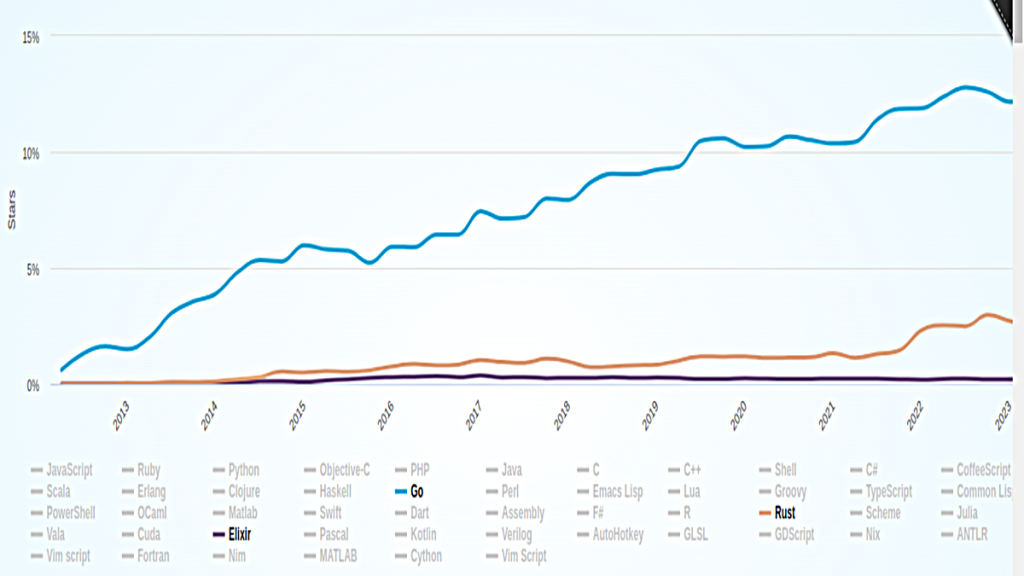
Go is way ahead of Rust and Elixir
Below are some differences between Elixir, Rust, and Go:
| Elixir | Rust | Go | |
| Purpose | for building scalable and fault-tolerant distributed systems | for low-level system development, such as operating systems, device drivers, and embedded systems | commonly used for building web services, networked applications, and distributed systems |
| Type System | Dynamic | Static | Static |
| Concurrency | highly concurrent and fault-tolerant systems through the Erlang VM | provides fine-grained control over threads and memory | includes goroutines and channels as first-class concurrency primitives |
| Ease of Learning | Hard | Very Hard | Medium |
Rust and Go are great for server-side programs, while Elixir is suitable for web apps through the Phoenix Framework. Many tech companies have saved money by switching to Elixir.
Elixir And Erlang
Elixir was born out of the need to address scalability and maintainability issues in the Ruby on Rails framework. It was created by José Valim, a well-known Ruby developer and contributor to Ruby on Rails, in 2011.
It runs on the Erlang Virtual Machine (BEAM) to have the productivity of Ruby while taking advantage of Erlang’s concurrency and fault-tolerance capabilities.
Elixir Saves Money (And The Earth)
Paraxial says Elixir saves Pinterest $2 million a year in server costs.
Steve Cohen of Pinterest says they reduced their servers by 95% from 1,400 after converting several parts to Elixir. According to him, one of the systems that ran on 200 Python servers now runs on 4 Elixir servers.
The combined effect of better architecture and Elixir saved Pinterest over $2 million per year in server costs. In addition, the performance and reliability of the systems went up despite running on drastically less hardware.
When their notifications system was running on Java, it was on 30 c32.xl instances. When they switched to Elixir, they could run on 15—despite running on less hardware, the response times dropped significantly, as did errors.
Analogy With Other Languages
The table below will help people understand the rough counterparts of Elixir with other more popular languages.
| Language | Erlang | Java | Ruby | Python | Javascript (Dart) |
| Easier Language | Elixir | Kotlin, Groovy | Ruby DSL | Python DSL | Dart |
| VM or Interpreter | Beam | JVM | Ruby Interpreter | Python Interpreter | Dart Compiler |
| Libraries | OTP, Packages | JDK, Dependency | Gems | Packages | Packages |
| ORM | Ecto SQL | JDBC | ActiveRecord | SQLAlchemy | Postgres |
| Jobs | GenServer | JobRunr | Sidekiq | Celery | Isolates |
| Build Tool | Mix | Maven, Gradle | Bundler | Pip | Build |
| Web | Phoenix | Spring MVC | Rails | Django | Flutter Web |
| Websockets: | LiveView | Spring-Websocket | ActionCable | Django Sockets | Flutter web_socket_channel |
Issues With Elixir
The big problem with Elixir is its lack of jobs and interest. Despite its high performance, this is because it is a problematic functional programming language with a steep learning curve, though not as tricky as Rust.
Elixir differs significantly from object-oriented programming languages, such as Java and C#, taught in schools. As a result, few people commit to learning it, leading to a lack of popularity and subsequent interest.
However, the attractive roadmap of Elixir, heading towards LiveView and deep learning via Nx and Axion, is enough to offset its initial disadvantages.


