



Are you constantly battling to rank higher on search engine results but unsure how to forge ahead? If you’re like many business professionals and entrepreneurs, you may find yourself overwhelmed by the constantly evolving field of search engine optimization (SEO). It’s crucial to adapt and apply effective SEO optimization techniques continually.
The digital market, as does the algorithm for ranking web pages, constantly evolves. Today, the difference between having a website merely appear online and having it effectively serve your business persuasively is found in how well you do SEO. But with a myriad of complex jargon required, SEO might appear daunting.
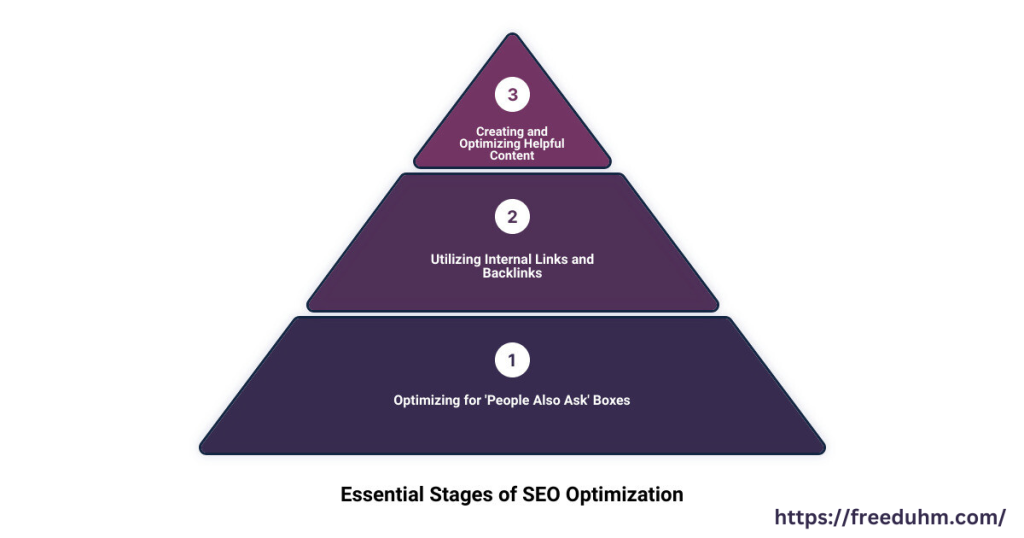
Here’s a quick snapshot of SEO techniques you will learn in this article. This concise list will give a brief oversight of the top techniques that will be elaborated upon:
- Building a Fast, Mobile-friendly Website
- Targeting Long-tail Keywords
- Optimizing Local Listings
- Creating and Optimizing Helpful Content
- Re-optimizing Past Content
- Utilizing Internal Links and Backlinks
- Analyzing Competitors’ SEO Strategies
- Optimizing for “People Also Ask” Boxes
- Avoiding Black Hat SEO Techniques
- Implementing a Human-centered Marketing Approach to SEO
We will deconstruct the intricacies of SEO optimization techniques, presenting them clearly and in an easy-to-understand way. Our goal is to empower you to implement these techniques and achieve improved search rankings for your business or brand.

Understanding The Importance Of SEO For Online Businesses
The digital landscape has transformed dramatically over the past few years, and SEO (Search Engine Optimization) has emerged as a crucial player. SEO refers to optimizing your website’s content, structure, and code to improve its visibility on search engines like Google. By implementing effective SEO optimization techniques, you can rank higher in the search engine results pages (SERPs), attracting more traffic to your website.
But Why Should You Care About SEO?
For starters, SEO is a cost-effective way to increase your online visibility. Unlike paid advertising, where your reach typically declines as soon as you stop paying, a well-optimized piece of content can continue to attract traffic months or even years after its creation.
SEO helps you reach your target audience more effectively. Organic search is compelling because the users who come across your content are actively looking for it. This usually results in higher-quality leads and, consequently, increased engagement and conversions.
Additionally, SEO improves the user experience on your website. A user-friendly website is more likely to retain visitors, encourage them to explore more pages and convert them into customers.
At Freeduhm, we understand the importance of SEO in today’s digital world. We believe that SEO is not just about pleasing search engine algorithms; it’s also about providing valuable and relevant content to your audience. Your content should be written for humans and optimized for search engines, not vice versa.
In the following sections, we will delve deeper into the essential SEO optimization techniques you can use to improve your search rankings and grow your online business.
1. Building a Fast, Mobile-friendly Website
Enhancing the speed and mobile-friendliness of your website is one of the critical SEO optimization techniques that can significantly impact your search rankings.
Importance Of Core Web Vitals In SEO
Google has emphasized the importance of Core Web Vitals in its ranking algorithm. These metrics focus on three crucial aspects of user experience—loading, interactivity, and visual stability. In particular, Google’s page experience update has made optimizing page speed more essential. A faster, more responsive website does not only improve user experience but also generates better conversions and improves your rankings.
Strategies For Improving Page Loading Speed
To ensure that your website loads quickly, consider the following strategies:
- Delete old or defunct plugins: Over time, websites can become cluttered with unused plugins, slowing down your site. Regularly review your plugins and remove those that are no longer necessary.
- Optimize and compress images: Large image files can significantly slow down your page loading times. Use tools to compress images without losing quality.
- Clean up your code: Minimizing the amount of code on your site can help improve loading times. This can involve removing unnecessary characters, whitespace, or code comments.
- Use tools for regular monitoring: Tools like Google Page Speed Insights or GTmetrix can help you monitor your website’s speed and suggest areas for improvement.
Making Your Website Mobile-friendly
With the rise in mobile device usage, your website must be mobile-friendly. This means that your website adapts and functions seamlessly on various screen sizes. Google’s mobile-first indexing primarily uses the mobile version of a website’s content for indexing and ranking, making mobile optimization a necessity.
A mobile-friendly website provides a seamless user experience with fast loading times, easy navigation, and a responsive design that adapts to different screen sizes. In addition to offering a better user experience, a mobile-friendly website enhances your search visibility, making it a crucial aspect of SEO optimization techniques.
Building a fast, mobile-friendly website can significantly improve your website’s user experience and search engine rankings, thereby growing your online visibility and business.
2. Targeting Long-Tail Keywords
As we delve into SEO optimization techniques, another strategy that significantly improves search rankings is targeting long-tail keywords.
Identifying Long-Tail Keywords
Long-tail keywords are more specific and often longer phrases that visitors are more likely to use when they’re closer to a point-of-purchase or using voice search. They’re a bit counter-intuitive initially, but they can be hugely valuable if you know how to use them.
As per WordStream, over a third of Google’s search queries feature four or more words, indicating the prevalence of long-tail keywords. Identifying these keywords involves profoundly understanding your business, audience, and industry. You can use tools like Google Keyword Planner, Ahrefs, or your website’s search bar to aid this process.
Studying the keywords used by your competitors and identifying gaps can give you an edge. The key here is to focus on keywords with high relevance, acceptable search volume, and low competition.
Incorporating Long-Tail Keywords Into Your Content
Once you’ve identified your long-tail keywords, the next step is to incorporate them into your content. But remember, the goal is to write for humans first and search engines second. It’s not just about stuffing these keywords into your content. They should be placed naturally and contextually within your content, titles, meta descriptions, and even within your URLs and the anchor text of your links.
Also, remember that SEO drives 1000%+ more traffic than organic social media, which dominates over half of the online traffic. This makes the strategic placement of these keywords even more critical.
In summary, targeting long-tail keywords is critical to SEO optimization techniques. It allows you to create more focused content to drive more qualified traffic to your site, improving your overall search rankings.
In our next section, we’ll explore another crucial aspect of SEO – optimizing local listings. So, stay tuned!
3. Optimizing Local Listings For SEO
The location or area might seem small, but local is also a king, especially when you’re a business is trying to attract a local audience. That’s where Local SEO comes into play.
Importance Of Local SEO
Local SEO is vital for businesses seeking to increase visibility in their local area. It’s an essential aspect of SEO optimization techniques, aiming to optimize a website to be more visible in local search results.
Local SEO helps businesses reach their target audience right where they are. By optimizing their website for local search results, businesses can ensure they appear in the search results of people looking for services in their local area. This makes businesses readily available to potential customers who might otherwise miss them.
Steps To Optimize Your Local Listings
We understand the importance of local SEO and have some recommendations for optimizing your local listings.
- Claim Your Google My Business Listing: This is the first and most crucial step. If you haven’t done so, claim your Google My Business listing. Ensure all information is accurate and up to date.
- Optimize Your Listing with Relevant Information: Provide as much information as possible about your business. Include your business name, address, phone number, website URL, hours of operation, and a brief business description.
- Collect and Respond to Reviews: Encourage your customers to leave reviews. Not only does this provide valuable feedback, but it also improves your local SEO. Make sure to respond to reviews, both positive and negative. This shows you value your customers and their experiences.
- Use Local Keywords: Incorporate local keywords into your website and content. These are keywords that are specifically relevant to your local area.
Local SEO is just one aspect of our comprehensive SEO optimization techniques. By focusing on local SEO, businesses can effectively reach their target audience, increase their visibility in local search results, and drive more traffic to their website.
Our next topic will dive into creating and optimizing helpful content.
4. Creating And Optimizing Helpful Content
In our continuous journey to improve search rankings, the next critical aspect of our SEO optimization techniques revolves around content. Not just any content but content specifically tailored to meet your users’ needs and solve their issues.
Understanding User Intent For Content Creation
When it comes to creating content, understanding user intent is vital. User intent means knowing what your readers want and giving it to them. This requires identifying the words or phrases a user might use to search for a piece of your content and then tailoring your content to match those search terms. As stated, a user familiar with the topic might use different keywords than someone new to the subject.
For instance, an experienced football fan might search for “FIFA,” while a novice might use a more general term like “football playoffs.” Anticipating and accounting for these differences while writing your content could yield positive results.
To understand user intent, Google Ads offers a useful Keyword Planner. This tool helps you discover new keyword variations and see the approximate search volume for each keyword. Furthermore, Google Search Console provides the top search queries for which your site appears, helping you better understand your user’s needs.
Techniques For Content Optimization
Once you’ve created valuable content that aligns with user intent, the next step is to optimize it for SEO. This involves refining your content to increase visibility and improve your site’s ranking on search engine results pages (SERPs).
Make your content interesting and valuable; compelling content will likely influence your website more than any other factor. It helps build your site’s reputation with both users and search engines.
Organizing your topics and breaking your content into logical chunks or divisions helps users find what they want faster. Additionally, create fresh, unique content. New content keeps your existing visitors coming back and attracts new ones.
Optimize your content for your users, not search engines. Designing your site while keeping your visitors’ needs in mind and ensuring that it’s easily accessible to search engines usually yields positive results.
Content is potent in our SEO optimization techniques. When crafted and optimized correctly, it can significantly improve your site’s visibility and rankings, increasing traffic and conversions.
5. Re-Optimizing Past Content
One of the most effective SEO optimization techniques is revisiting and re-optimizing your past content. Just because a blog post or an article was published months or years ago doesn’t mean it can’t still do wonders for your SEO today. In fact, by updating and optimizing old content, you can significantly boost your site’s visibility and rankings.
Identifying Content For Re-optimization
Before re-optimizing your past content, identify which pieces would benefit most from an update. Look for content already ranking on the second or third page of search results. These are the low-hanging fruits that could potentially rank on the first page with a little bit of tweaking.
Use tools like Google Analytics or the Performance Report in Google Search Console to determine which content is driving traffic to your site and which could use a boost.
Steps For Effective Content Re-Optimization
Once you’ve identified the content to re-optimize, it’s time to roll up your sleeves and get to work. Here are some steps to help you effectively re-optimize your past content:
1. Update Information: Ensure all the information in your content is current and accurate. Update any outdated statistics, facts, or links.
2. Improve Readability: Break up large blocks of text, use subheadings, bullet points, or numbered lists, and ensure your content is easy to read and understand.
3. Incorporate Relevant Keywords: Use your research keywords to incorporate relevant long-tail and short-tail keywords into your content, title tags, and meta descriptions. Don’t overdo it—keyword stuffing can harm your SEO.
4. Add Internal and External Links: Link to other related content on your site to keep visitors engaged and spending more time there. Also, link to reputable external sources to increase the credibility of your content.
5. Optimize Images: If your content includes images, ensure they’re optimized for SEO too. Use descriptive file names and alt text, and compress the images to improve page speed.
Re-optimizing your past content is an effective SEO technique that often gets overlooked. By investing time in updating and improving your old content, you can give it a new lease of life and boost your website’s overall SEO.
SEO is not a one-time effort but a continuous process. Keep analyzing your content’s performance and make necessary adjustments to stay ahead. At Freeduhm, we believe in leveraging data-driven insights to create and optimize content that resonates with our audience and meets their needs. After all, the ultimate goal of SEO is to provide valuable and relevant content to your users.
6. Utilizing Internal Links And Backlinks
One of the core SEO optimization techniques involves the strategic use of internal links and backlinks. These two components are crucial in enhancing your website’s SEO performance navigability and boosting its credibility in the eyes of search engines.
Understanding The Role Of Internal Links In SEO
Internal links are hyperlinks that connect one page on your site to another. They help establish a hierarchy on your site, allowing search engines to understand the relationship between different pages and posts. Beyond helping search engine crawlers, internal linking enhances the user experience by providing your audience with additional reading options and easy navigation.
For instance, if we’re discussing SEO techniques in a blog post, we might link to a more in-depth article on our site about keyword research or link building. This keeps the reader engaged by offering them more relevant content and signals to search engines that these linked pages are related and valuable.
The key is to link relevant pages together naturally, enhancing the user experience. Overdoing it or forcing links where they don’t belong can harm your SEO efforts.
Building a Strong Backlink Profile
On the other hand, backlinks are links from other websites pointing to yours. High-quality backlinks signal to search engines that your content is trustworthy and authoritative. When reputable websites link back to your site, it boosts your website’s credibility and can significantly improve your search engine rankings.
However, not all backlinks are created equal. Links from dubious or low-quality websites can harm your reputation and negatively impact your SEO. It’s crucial to focus on quality over quantity when building backlinks. You can use tools like SEMrush or Ahrefs, as mentioned in the research, to analyze your backlink profile and identify any harmful links.
Building a strong backlink profile isn’t an overnight task. It involves reaching out to relevant, high-quality websites, providing valuable content that others want to link to, and sometimes, leveraging broken link-building techniques to earn backlinks.
By understanding the importance of a strong backlink profile and its role in a successful SEO strategy, you can continuously strive to earn high-quality backlinks to your site.
In the next section, we’ll explore how you can analyze your competitors’ SEO strategies to gain an edge.
7. Analyzing Competitors’ SEO Strategies
Cracking the code of SEO optimization techniques is not just about what we do for our website but also about understanding what our competitors are doing right. By keeping a close eye on our competitors, we can uncover opportunities to improve our strategies and gain a competitive edge.
Conducting Competitor Keyword Research
Keywords form the backbone of any SEO strategy. Understanding the keywords our competitors are ranking for can give us valuable insights into their strategy and reveal potential keywords we might have overlooked.
One method to conduct competitor keyword research is using tools like SEMrush’s Organic Research. By simply entering a competitor’s URL, we can discover the keywords they are ranking for, their position changes, and their top-performing pages.
This technique is not about copying what our competitors are doing. Instead, it’s about identifying gaps in our strategy. For instance, if a competitor is ranking for a keyword we haven’t targeted yet, it can be an opportunity to create new content or optimize existing content around that keyword.
Analyzing Competitors’ Backlink Profiles
Backlinks or links from other websites pointing to our site are significant in search engine rankings. They serve as votes of confidence, indicating to search engines that our content is valuable and trustworthy.
However, not all backlinks are created equal. The quality and relevance of the websites linking to us can significantly impact our SEO performance. Understanding where our competitors are getting their backlinks is crucial, and whether we can earn links from the same sources is vital.
Again, tools like SEMrush and Ahrefs can be instrumental in analyzing competitors’ backlink profiles. They can provide insights into the total number of backlinks, the quality of these backlinks, and the anchor text used.
This information can help us identify potential link-building opportunities. For instance, if a high-quality website links to our competitor but not to us, we can reach out to that site and try to earn a link.
The goal here is not to replicate our competitors’ backlink profiles but to understand their strategies, learn from them, and ultimately build a more robust and diverse backlink profile for our site.
We can gain insights and uncover opportunities to improve our SEO optimization techniques by conducting a thorough competitor analysis. It’s a critical step in staying ahead in the highly competitive SEO landscape.
In the next section of this article, we’ll discuss optimizing for ‘People Also Ask’ boxes, another critical aspect of a successful SEO strategy.
8. Optimizing For “People Also Ask” Boxes
As we delve further into essential SEO optimization techniques, it’s time to discuss an often overlooked but incredibly valuable feature on Google’s Search Engine Results Pages (SERPs): the “People Also Ask” (PAA) boxes. These boxes present a unique opportunity to boost your website’s visibility and enhance your SEO strategy.
Understanding The Role Of PAA Boxes In SEO
PAA boxes are a feature of Google’s SERP that displays related questions to a user’s original search query. These questions expand to provide quick answers, often pulling information from high-ranking websites.
Not only do PAA boxes provide users with relevant and valuable information, but they are also significant in SEO. By optimizing for these boxes, you can increase your website’s click-through rate (CTR), improve your position in the SERPs, and enhance your brand’s visibility.
Strategies For PAA Box Optimization
Optimizing for PAA boxes requires a specific set of strategies. Here are a few techniques we recommend:
1. Provide Clear, Concise Answers: Start your article with a dictionary-style answer, providing a clear and concise response to a potential question. This can increase the likelihood of your content being featured in a PAA box.
2. Use Lists: Incorporate numbered and unnumbered lists into your content. Google often pulls list-style information for PAA boxes, especially for how-to or process-related queries.
3. Incorporate Questions in Subheaders: Use questions in your subheaders that are related to your topic. This can help your content align more closely with the queries in PAA boxes.
4. Utilize SEO Tools: Consider using tools like SEMrush’s Position Tracking to monitor the existing SERP features for your keywords and identify opportunities to target PAA boxes.
SEO is not just about keywords or backlinks; it’s about understanding and leveraging the various features Google offers to provide valuable content to users. By optimizing for PAA boxes, you can improve your SEO strategy and enhance your website’s search rankings.
In the next section, we’ll discuss the importance of avoiding black hat SEO techniques, ensuring your SEO strategy remains ethical and practical.
9. Avoiding Black Hat SEO Techniques
SEO optimization techniques are the backbone of successful online marketing. But as we navigate the SEO landscape, avoiding certain practices is crucial. We’re talking about ‘Black Hat SEO,’ a term you might have encountered. But what is it, and why should you avoid it?
Understanding Black Hat SEO
Black hat SEO is a term for aggressive SEO strategies that focus only on search engines, not a human audience, and often violate search engine guidelines. These practices include keyword stuffing, invisible text, adding unrelated keywords to the content, and doorway pages. While these methods might boost rankings quickly, they do not provide value to users and are generally frowned upon by search engines.
In the earlier days of SEO, some marketers tried to game the system using these techniques. But search engines have gotten smarter. They now prioritize valuable, user-focused content over pages filled with irrelevant keywords or deceptive tactics.
Consequences Of Using Black Hat SEO Techniques
The consequences of using black hat SEO techniques can be severe. Search engines, like Google, have strict policies against these practices. Your site could be penalized or even banned from search results if caught. This could lead to a significant decrease in traffic and visibility, devastating your business.
Black hat SEO techniques do not contribute to a positive user experience. Your content should be written for humans first, then optimized for search engines, not vice versa. Ignoring this principle can lead to a high bounce rate, low engagement, and, ultimately, a loss of credibility and trust among your audience.
Instead of resorting to these risky tactics, investing time and effort in creating high-quality content, optimizing for mobile users, and building natural backlinks is advisable. Search engines approve these white hat SEO techniques, provide long-term results, and create a better user experience.
We advocate for ethical and effective SEO practices. The following section will discuss how a human-centered marketing approach contributes to SEO success. Sustainable SEO success lies in providing real value to your audience, not in manipulating search engine algorithms.
10. Implementing a Human-Centered Marketing Approach To SEO
SEO is not just about search engines; it’s about people; it’s crucial to remember the importance of user experience in SEO. The better the experience users have on your site, the more likely they are to engage with your content, share it, and return for more. This user engagement can lead to better search engine rankings.
Understanding The Importance Of User Experience In SEO
Google and other search engines aim to provide users with the most relevant and high-quality results for their search queries. As such, they consider user experience signals when ranking websites. These signals can include metrics like bounce rate, page views, and time spent on the page – all indicators of a user’s satisfaction with your website.
Therefore, by enhancing your site’s user experience, you’re serving your audience better and improving your site’s performance in search engine rankings.
Strategies For a Human-Centered SEO Approach
So, how can you implement a human-centered approach in your SEO optimization techniques? Here are some strategies we advocate:
1. Create Quality Content: This is the cornerstone of a human-centered SEO strategy. Your content should be engaging, valuable, and relevant to your target audience. Keep your content fresh and updated to maintain its relevance.
2. Improve Site Usability: Make your website easy to navigate. A well-structured site with straightforward and intuitive navigation can significantly enhance the user experience.
3. Optimize For Mobile: With most online activities taking place on mobile devices nowadays, ensuring your website is mobile-friendly is crucial. This includes responsive design and fast loading times on mobile devices.
4. Enhance Page Speed: Slow page loading times can frustrate users and lead them to leave your site. Use tools like Google’s PageSpeed Insights to evaluate and improve your page speed.
5. Use Visuals Wisely: Visuals can enhance user engagement but must be used wisely. Ensure they’re optimized for fast loading and are relevant to your content.
By focusing on your users and striving to provide them with the best experience possible, you’ll be on the right path to SEO success. A happy user is likelier to become a loyal customer, and a satisfied customer can become your brand’s best advocate. This approach improves your SEO and contributes to your overall business success.
Implementing a human-centered approach to your SEO strategy will result in more organic traffic to your website and more eyes on your content. It’s a great addition to your organic marketing efforts and an essential aspect of sustainable and ethical SEO practice.
Wrapping Up: SEO Optimization Techniques For Improved Search Rankings


In the digital world, SEO optimization techniques are pivotal in enhancing your online visibility, driving traffic to your website, and boosting your business success. You can significantly improve your search rankings by implementing the right strategies, from creating a fast, mobile-friendly website to optimizing your content and local listings.
Long-tail keywords, for instance, can attract a more targeted audience and result in higher conversion rates. Re-optimizing your past content lets you keep your website fresh and relevant, while a strong backlink profile can significantly enhance your website’s authority.
SEO isn’t a one-time endeavor—it requires consistent efforts and adaptation to the ever-changing search engine algorithms. Regularly analyzing your competitors’ SEO strategies can provide invaluable insights into what works and doesn’t in your industry. While using black hat SEO techniques for quick gains may be tempting, staying ethical and focusing on a human-centered approach that prioritizes user experience is essential.
We understand the importance of SEO and are committed to helping businesses of all sizes navigate the digital landscape. Our wealth of resources, including articles on digital marketing and technological advancements, are designed to equip you with the tools and knowledge you need to stay ahead of the competition.
As we wrap up this discussion on SEO optimization techniques, it’s clear that learning and mastering SEO is a journey. It might seem like a slow burn at first, but with patience and consistency, you’ll see significant improvement in your website’s traffic and rankings. The effectiveness of SEO lies in its potential to provide long-lasting results. So, keep investing in SEO, keep learning, and keep adapting. Your efforts will pay off and have improved search rankings and increased business success.
For a deeper dive into SEO and other digital marketing strategies, check out our business development and online business sections. Happy optimizing!


