Introduction
Qualitative response analysis is a vital component of research that delves into exploring non-numeric data, often in the form of open-ended text, interviews, or observations. While quantitative data provides numerical insights and statistical patterns, qualitative data is all about understanding the richness and depth of human experiences, opinions, and behaviors. It’s a qualitative approach that complements the quantitative, allowing researchers to understand complex phenomena holistically.
In today’s research landscape, the analysis of the qualitative responses has gained prominence due to its ability to unveil hidden insights, delve into the ‘why’ and ‘how’ behind human actions, and provide context to statistical findings. Whether understanding customer sentiments, exploring social phenomena, or unraveling intricate narratives, qualitative analysis is instrumental in revealing the nuances that quantitative data alone cannot capture.
One of the primary distinctions between qualitative and quantitative data is that the former is inherently subjective. It’s about people’s perspectives, beliefs, emotions, and experiences. Analyzing qualitative responses involves diving into the sea of unstructured data, making sense of narratives, identifying recurring themes, and interpreting the subtle details that often escape quantitative scrutiny.
Data Collection And Preprocessing

The process of qualitative response analysis begins with data collection, a stage that can be as varied and creative as the research itself. Researchers typically gather qualitative data through interviews, surveys with open-ended questions, focus groups, observations, or content from social media and textual sources. These responses often come in text, audio, or visual recordings and carry diverse insights, opinions, and experiences. Qualitative data’s raw, unstructured nature makes it both a treasure trove of information and a complex challenge.
Once the data is collected, the next step in the journey of qualitative response analysis involves preprocessing. This is a crucial phase where researchers organize, clean, and prepare the data for analysis. It often begins with transcription for textual data or audio recordings, transforming spoken words into written text. Transcription is essential as it helps ensure the data is in a format suitable for analysis.
Data preprocessing extends beyond transcription. It may involve removing personally identifiable information (PII) or confidential details to protect respondents’ privacy. Researchers also need to decide on the scope of the data. Do they need to analyze every response, or is a representative sample sufficient? Making these decisions at the preprocessing stage is essential for efficiency and focus in the analysis process.
Furthermore, researchers might apply some basic data cleaning, which includes identifying and correcting spelling errors, ensuring consistent formatting, and making the text more readable. Removing extraneous information, such as filler words, unrelated content, or irrelevant anecdotes, helps streamline the data to concentrate on the core information.
Overall, data collection and preprocessing are the foundation of qualitative response analysis. These initial steps not only determine the quality of the data but also set the stage for the following analytical process. It’s a blend of art and science, where researchers must balance respecting each response’s uniqueness and preparing the data for systematic exploration and interpretation.
Coding And Categorization
Coding and categorization are the heart and soul of qualitative response analysis, where the seemingly chaotic world of qualitative data starts to take shape and reveal patterns. It’s the process of organizing, labeling, and making sense of the information, turning unstructured responses into structured data that can be analyzed systematically.
Coding involves assigning labels or codes to segments of qualitative data based on their content. These labels or codes are like tags that summarize the essence of the response. They can be single words or short phrases that capture the key themes, concepts, or ideas expressed in the text. The aim is to reduce the complexity of the data while preserving its richness, distilling it into manageable components that can be analyzed, compared, and interpreted.
The coding process is often iterative, where researchers review the data multiple times, refining and expanding their list of codes as they delve deeper into the material. This process demands analytical and interpretive skills as the researchers must grapple with language, context, and meaning nuances. It’s not just about what is said but how it is displayed and what it implies.
Once coding is complete, categorization comes into play. This involves grouping codes with similar meanings or themes into broader categories. For instance, if codes like “stress at work” and “long working hours” are assigned, these may be categorized under “work-related stress.” Categorization aims to bring order to the coded data, making it more accessible for analysis and interpretation. It allows researchers to identify overarching patterns, trends, and relationships within the data.
Coding and categorization are often conducted manually or using specialized software designed for qualitative analysis. The choice of approach depends on the volume and complexity of the data and the researcher’s preferences. Regardless of the method, the goal remains to uncover the qualitative responses’ underlying structures, themes, and narratives.
In essence, coding and categorization bridge the raw data and the final insights. They transform the qualitative responses from a sea of words into a structured and organized dataset from which researchers can explore, dissect, and ultimately derive meaning.
Analytical Methods And Techniques
In the realm of qualitative response analysis, various analytical methods and techniques come into play, each with its unique approach to unraveling the depth and breadth of the data. The choice of analytical method often depends on the research objectives, the nature of the data, and the preferred level of depth in analysis.
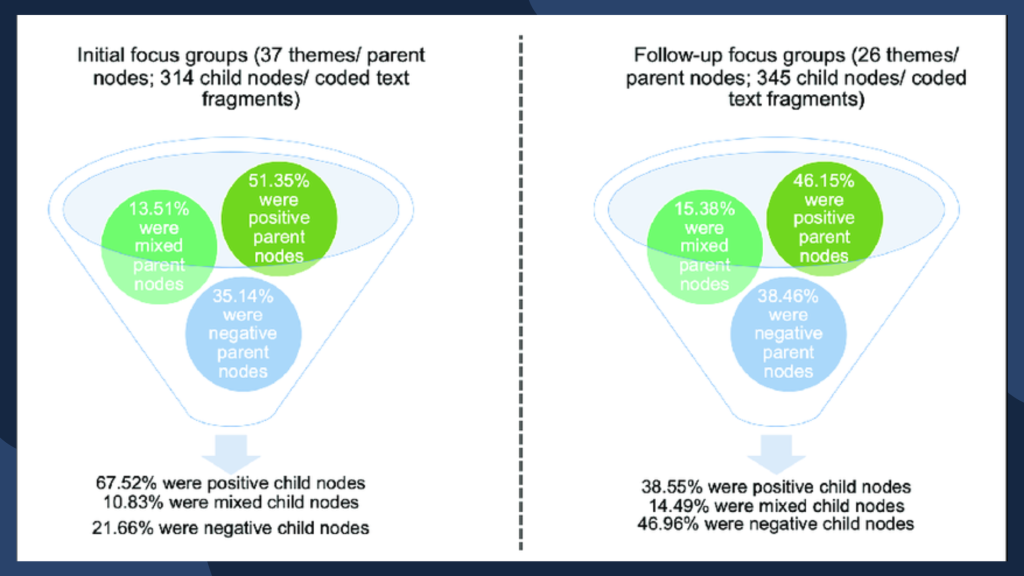
Qualitative Thematic Analysis, Image By: Research Gate
Thematic analysis is one of the most widely used techniques. It involves identifying and analyzing patterns, or “themes,” within the data. Researchers examine recurring ideas, concepts, or phrases and cluster them into meaningful themes that capture the essence of the responses. Thematic analysis is flexible, making it suitable for various research questions.
Content analysis, on the other hand, takes a more structured approach. Researchers define specific categories or codes before the examination, allowing for a more quantitative element in qualitative data. This technique is often employed in studies where quantifiable results are desired. Content analysis can systematically measure the frequency or prevalence of specific ideas or themes within the data.
Another approach is grounded theory, a method often used to develop new ideas or concepts from the data. In grounded theory, researchers begin without preconceived categories or themes. Instead, they “ground” their thesis in the data, systematically building concepts, categories, and hypotheses as they analyze the responses. It’s a dynamic and inductive approach to qualitative analysis, ideal for research exploring new territories.
Narrative analysis is beneficial when the responses involve storytelling or personal narratives. Researchers examine these stories’ structure, content, and meaning, often focusing on the narrative elements, such as plot, characters, and emotions. Narrative analysis is adept at uncovering the personal and cultural meanings embedded in qualitative data.
Autoethnography and ethnographic content analysis emphasize the cultural and social context within the responses. Researchers delve into the cultural aspects, norms, and values reflected in the data, aiming to understand the broader sociocultural implications of the qualitative material.
Technological evolution has recently introduced computer-assisted qualitative data analysis software (CAQDAS). These tools aid researchers in organizing, coding, and managing large volumes of qualitative data, making the analytical process more efficient and systematic.
Ultimately, the choice of analytical method and techniques depends on the research goals and the nature of the qualitative data. Regardless of the approach, the essence of qualitative response analysis remains rooted in the meticulous exploration and interpretation of the stories, perspectives, and insights embedded in the data. It’s a process that demands a blend of art and science, where researchers navigate the complexity of human experiences and narratives.
Interpretation And Findings

The culmination of the qualitative response analysis journey leads to the interpretation of findings. Researchers extract meaning, insights, and a deeper understanding from this phase’s coded and categorized data. This is when the richness of the qualitative responses is transformed into actionable knowledge, contributing to the research objectives or questions.
During interpretation, researchers explore the themes, patterns, and categories that emerged from the data. They dig into the nuances, seeking to uncover the ‘whys’ and ‘hows’ behind the responses. This interpretive process often involves reflecting on the context of the answers and considering how individual perspectives connect to larger societal or cultural narratives.
Interpretation also entails comparing and contrasting different responses to identify similarities and differences. It’s about discovering the outliers, the unexpected insights, and the contradictions within the data. Researchers aim to provide a holistic understanding of the subject matter by examining the spectrum of responses and the variations in perspectives.
One key aspect of interpretation is the researcher’s reflexivity, acknowledging their biases and perspectives that may influence the analysis. Awareness of how their background, experiences, and beliefs can shape the interpretation is critical for maintaining objectivity and rigor in the study.
The findings extracted during interpretation are often presented in a narrative format. Researchers craft a compelling story that conveys the essence of the responses, the overarching themes, and the insights gained. This narrative approach not only makes the findings more accessible but also describes the depth and context of the qualitative data.
Interpreted findings are a treasure trove of insights that can contribute significantly to a particular field. They provide a qualitative depth that quantitative data often cannot achieve, offering a comprehensive understanding of the research. The findings may also uncover unexpected insights or suggest new research directions, making qualitative response analysis a dynamic and valuable aspect of the research process.
In summary, interpretation and findings in qualitative response analysis are about making sense of the rich tapestry of narratives and responses. It’s a journey into the depth of human experiences, perspectives, and insights, transforming raw data into actionable knowledge that advances our understanding of the world.
Challenges And Limitations
While qualitative response analysis is vital for exploring the depth of human experiences, researchers must navigate its share of challenges and limitations.
One of the foremost challenges is the subjectivity inherent in qualitative data. The researchers’ perspectives, beliefs, and experiences influence the interpretation of responses. This subjectivity can introduce bias, making it essential for researchers to engage in reflexivity, acknowledging and addressing their potential preferences.
The volume of data is another challenge. Qualitative data can be voluminous, particularly in studies involving multiple participants or extensive responses. Managing and analyzing large datasets demands significant time and effort, making the process labor-intensive.
Ensuring the confidentiality and anonymity of respondents is crucial, particularly in studies involving sensitive topics. Researchers must take measures to protect the identities and privacy of participants, which can be challenging when working with qualitative data.
Generalizability can be a limitation in qualitative analysis. Qualitative research often focuses on specific contexts or individuals, which may limit the ability to generalize findings to broader populations. The emphasis is on depth, not breadth.
Maintaining rigor and reliability is an ongoing challenge. Unlike quantitative research, where statistical tools provide a degree of objectivity, qualitative analysis relies on researchers’ interpretation. Ensuring the reliability of findings and the consistency of the analysis process can be challenging.
There’s also the challenge of time. Qualitative response analysis is time-consuming, from data collection and preprocessing to coding, categorization, and interpretation. Researchers must invest substantial time to gain a comprehensive understanding of the data.
Lastly, qualitative analysis often lacks the statistical prowess associated with quantitative research. While it offers rich insights, the absence of statistical significance can make it challenging to persuade skeptics or contribute to evidence-based decision-making.
Despite these challenges and limitations, qualitative response analysis remains an invaluable tool in research. By understanding and navigating these challenges, researchers can harness the full potential of qualitative data to uncover meaningful insights and contribute to the broader body of knowledge.
The Implications
In the journey of qualitative response analysis, the conclusion is not merely the endpoint but a significant milestone. This phase involves synthesizing the interpreted findings, drawing connections to the research objectives or questions, and reflecting on the broader implications of the qualitative data.
One of the central tasks in the conclusion is to answer the ‘so what’ question. What do the findings mean? How do they contribute to our understanding of the subject matter? Researchers delve into the implications of their conclusions, considering their significance in the context of existing literature and real-world applications.
Conclusions often highlight the key themes, patterns, and insights that emerged during the analysis. Researchers articulate the overarching narratives from the responses, making the findings accessible to a broader audience. This narrative approach not only conveys the depth of the data but also connects the research to individuals’ lived experiences and stories.
The implications of qualitative response analysis extend beyond the research itself. Findings may have practical applications, influencing policy, practice, or decision-making. They may inspire further research in the field or serve as a basis for new theories or concepts. The qualitative depth of the data allows for a nuanced understanding that can be valuable in shaping actions or interventions.
Additionally, qualitative response analysis often uncovers the voices and perspectives of individuals whose experiences may have been overlooked or marginalized. It can amplify these voices and bring attention to issues or narratives otherwise underrepresented in research. This has significant social and ethical implications.
In conclusion, qualitative response analysis is a dynamic process that transforms raw data into valuable insights, stories, and understandings. It is a journey into the human experience, a process that demands both art and science, subjectivity and objectivity. The implications of qualitative analysis stretch beyond the research realm, influencing our understanding of the world, shaping policies, and giving voice to those who may not have been heard. It’s a crucial tool for exploring the richness of human experiences and narratives.