

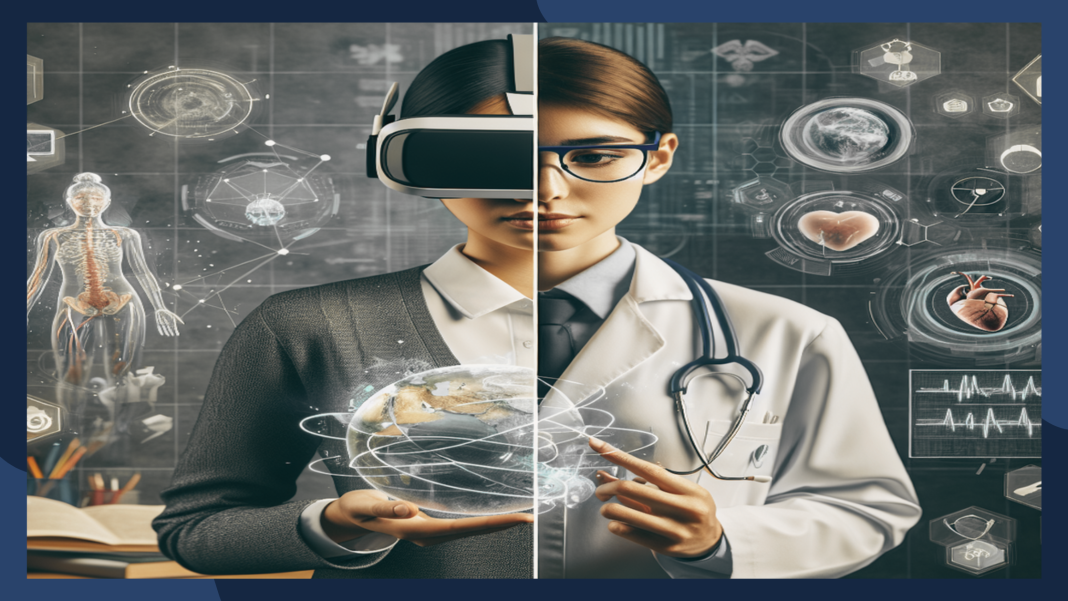
Virtual Reality (VR) and Augmented Reality (AR) technologies are reshaping the education and healthcare industries. These immersive technologies offer unique learning, training, and patient care opportunities. By allowing us to create interactive and immersive experiences, VR and AR reshape how we approach education and healthcare.
Education Industry
Enhanced Learning Experiences
VR and AR provide students with interactive and immersive learning experiences. Instead of reading about historical events or studying complex biological structures from textbooks, students can now step into virtual environments and explore these concepts firsthand. For example, they can walk through ancient civilizations, witness historical events, and dissect virtual organisms. This three-dimensional approach to learning fosters deeper understanding and knowledge retention.
Personalized Education
One of the most significant advantages of VR and AR in education is the ability to personalize and adapt learning experiences. Every student has a unique learning style and pace, and traditional classroom settings may not cater to individual needs. However, with VR and AR, students can learn at their own pace and receive customized feedback. These technologies can adapt to different learning styles and preferences, making education more inclusive and accessible for all students.
Virtual Field Trips
Logistical constraints and costs often limit traditional field trips. However, VR and AR enable virtual field trips, allowing students to visit places they may not have the opportunity to see in person. They can explore famous landmarks and experience different cultures, all from the comfort of their classrooms. These virtual field trips enhance students’ global awareness and understanding, opening their minds to new perspectives and ideas.
Medical Training
VR and AR are also transforming medical education and training. Healthcare professionals can now practice procedures and surgeries in a simulated environment, reducing the need for cadavers or live patients. These technologies provide a safe and controlled space for learners to gain practical skills and improve patient outcomes. For example, surgeons can use VR to simulate complex surgeries and practice intricate techniques before performing them on real patients. This enhances their skills, reduces the risk of errors, and improves patient safety.
Healthcare Industry
Surgical Planning And Visualization
Surgeons are using AR to provide real-time digital information during procedures. By overlaying patient data, such as CT scans or MRI images, onto the surgical field, surgeons can enhance precision and reduce the risk of errors. This technology allows surgeons to understand the patient’s anatomy better and can guide them during complex surgeries. Additionally, AR enables noninvasive assessment of wounds, helping healthcare providers determine the best treatment options.
Therapeutic Interventions
VR and AR are increasingly used in mental health therapy sessions to create immersive and therapeutic environments. Patients can engage in virtual reality exposure therapy to treat phobias, anxiety disorders, and post-traumatic stress disorder. Patients can confront and overcome their fears by simulating real-life scenarios in a controlled, safe, supportive environment. These technologies offer a new approach to therapy, providing patients with effective and personalized treatment options.
Medical Education And Training
Similar to its impact on general education, VR and AR are transforming medical education and training. Healthcare professionals can practice procedures and surgeries in a simulated environment, reducing the need for in-person training. This allows learners to gain practical skills and improve patient outcomes in a safe and controlled space. Medical students can use VR to practice diagnosing and treating various conditions, enhancing their knowledge and confidence before entering real clinical settings.
Patient Care And Rehabilitation
VR is being used to improve patient care and rehabilitation. Patients can engage in virtual reality-based exercises and activities to enhance mobility, balance, and cognitive function. For example, stroke patients can use VR to simulate real-life movements and regain motor skills. Additionally, VR offers distraction therapy for patients undergoing painful procedures, reducing anxiety and discomfort. By immersing patients in virtual environments, healthcare providers can enhance their overall well-being and recovery.
These examples are just the tip of the iceberg regarding VR and AR’s potential in education and healthcare. As these technologies evolve, we can expect even more innovative applications and advancements in these fields. The possibilities are endless, and the impact on education and healthcare is profound.
Experts Perspectives
As virtual reality (VR) and augmented reality (AR) technologies evolve, they’re revolutionizing sectors such as education and healthcare. We’ve gathered perspectives from three industry experts, including a Nurse Practitioner and CEOs, to shed light on this transformation. Discover how these innovations impact patients, from enhancing healthcare with immersive tech to boosting learning and patient care.
- Enhancing Healthcare With Immersive Tech
- Transforming Education And Patient Care
- Immersive Tech Boosts Learning And Healthcare
Enhancing Healthcare With Immersive Tech
Advancements in VR and AR are reshaping industries like healthcare by providing immersive and realistic experiences that can enhance medical education, training, diagnosis, treatment, and rehabilitation. VR and AR can simulate various clinical scenarios and procedures, allowing users to interact with virtual patients, environments, and objects. For example, VR and AR can be used to train surgeons and other healthcare professionals in a safe and controlled manner without risking patient safety or wasting resources.
VR and AR can also be used to treat patients with various conditions, such as chronic pain, anxiety, phobias, post-traumatic stress disorder, and stroke, by offering distraction, exposure, relaxation, and stimulation. By providing personalized and accessible care and empowering patients to take an active role in their health, VR and AR can also improve patient engagement, satisfaction, and outcomes.

Trent Carter, Nurse Practitioner, Founder, Curednation
Transforming Education And Patient Care
VR and AR technologies have transformed traditional learning methods in education, making education more engaging and interactive. For example, VR simulations are crucial in medical education. Medical students can practice surgeries and other medical procedures virtually, providing a risk-free learning experience. This hands-on approach allows students to learn and make mistakes without real-world consequences, significantly enhancing their learning experience. One notable application is the use of VR for complex surgical training. Students can enter a fully immersive, 3D operating room and perform virtual surgeries that mimic real-life scenarios with high accuracy. This improves their technical skills and prepares them psychologically for real-life operations.
In healthcare, AR is being used to enhance patient care and treatment. A compelling example is the use of AR in assisting surgeries. Surgeons can use AR glasses or screens to display crucial patient information, like vital signs or 3D models of the patient’s anatomy, overlaid on their field of view during procedures. This technology allows surgeons real-time access to critical data without looking away from the surgical site, improving precision and safety. Additionally, AR is being used for patient rehabilitation. Through AR applications, patients recovering from strokes or injuries can engage in interactive exercises that are more motivating and adaptable to their rehabilitation needs.

Bruno Gavino, Founder, CEO, CodeDesign
Immersive Tech Boosts Learning And Healthcare
In education, VR and AR technologies offer immersive learning experiences, allowing students to explore subjects in a virtual environment. In healthcare, these advancements enable surgical simulations, medical training, and enhanced patient care through AR overlays. VR therapy aids in mental health treatment.
Both industries benefit from cost-effective training, improved skill retention, and enhanced diagnostics. VR and AR innovations reshape traditional approaches, providing more engaging and efficient solutions in education and healthcare, ultimately improving outcomes and experiences in these critical sectors.

Perry Zheng, Founder and CEO, Pallas
Wrapping Up
VR and AR are reshaping the education and healthcare industries by providing enhanced learning experiences, personalized education, virtual field trips, surgical planning and visualization, therapeutic interventions, medical education and training, and improved patient care and rehabilitation. These technologies can potentially revolutionize learning, training, and providing healthcare services. As we continue exploring and innovating in VR and AR, we can expect a future where education and healthcare are more immersive, inclusive, and effective than ever.
Read more articles on technology and health; we are a platform dedicated to exploring immersive technologies’ latest advancements and applications.


