

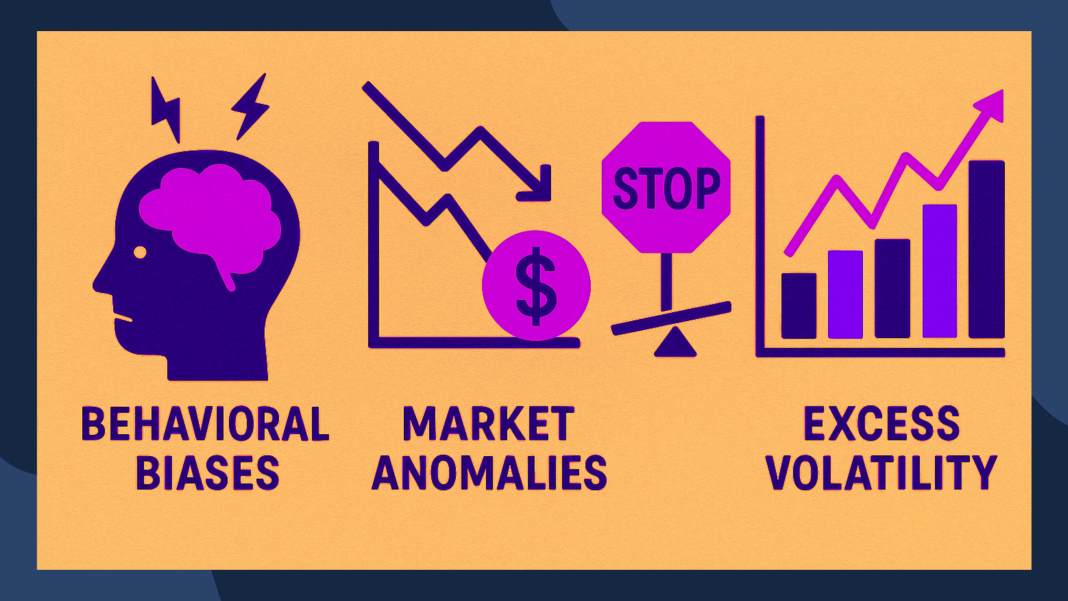
The Efficient Market Hypothesis (EMH) has long been a cornerstone of financial theory but faces mounting challenges in today’s complex markets. Let us examine the key arguments that question the validity of EMH, drawing on insights from leading financial experts and researchers. From market anomalies to real-world inconsistencies, discover why the idealized theory of efficient markets may not always align with market reality.
1. EMH: Markets Reflect All Available Information
The Efficient Market Hypothesis (EMH) posits that financial markets fully reflect all available information, making it impossible to consistently achieve higher returns than the market average through active stock picking or market timing. It operates on three levels: weak form, which suggests past prices can’t predict future performance; semi-strong form, which asserts that all publicly available information is reflected in prices; and strong form, which claims even insider information is incorporated into market prices. In theory, under the EMH, investors would be better off putting their money into a low-cost index fund rather than searching for the following big breakout stock.
Critics have numerous arguments against the EMH. One significant argument is the existence of anomalies like market bubbles or financial crises, where prices deviate wildly from any rational valuation. I once joked with a teammate at Spectup that the dot-com bubble wouldn’t have resembled a child discovering his father’s poker chips if markets were truly efficient. Behavioral finance is another substantial counterpoint, demonstrating how emotions and cognitive biases cause irrational decisions, reverberating through markets.
Additionally, the outperformance of legendary investors like Warren Buffett seems to defy this theory. I recall debating this with an investor we worked with at Spectup, and his perspective was that while EMH works broadly, talent, research, and occasional luck can still defy it at a micro level. For founders we’ve supported, this debate often sparks ideas about how market perceptions could influence their valuations, and we emphasize that timing and storytelling frequently matter as much as numbers. So, efficient? Perhaps in the big picture, but imperfect when examined closely.

Niclas Schlopsna, Managing Consultant & CEO, Spectup
2. Information Asymmetry And Unequal Access
One of the most significant cracks in the foundation of the Efficient Market Hypothesis, in my experience, is the assumption that everyone in the market operates with equal access to information. Frankly, that doesn’t hold water in the real world. Markets may be more transparent than fifty years ago, but they’re far from a level playing field. In theory, EMH suggests that the moment new information becomes available, it’s instantly priced in by rational actors. But who gets that information first and has the tools to act on it in milliseconds makes a world of difference.
Let me paint a clearer picture. Institutional investors—hedge funds, large asset managers, proprietary trading firms—have an enormous technological edge. We’re talking high-frequency trading algorithms, real-time data feeds, AI-enhanced research capabilities, and direct market access. These aren’t just perks—they’re advantages allowing them to spot and capitalize on inefficiencies long before the average investor reads the news headline. I’ve seen trades executed on machine-readable earnings reports before the earnings call began. That’s not efficiency in the way EMH envisions it—that’s privilege disguised as parity.
Now contrast that with retail investors. They rely on delayed news, sometimes filtered through social media, or biased analysis from third-party platforms. Even seasoned professionals without institutional backing often operate several steps behind. And it’s not just about speed. Information asymmetry also comes down to quality and interpretation. While retail investors may be drowning in data, they often lack the tools to separate signal from noise. That’s a recipe for inefficient pricing, not the efficient markets EMH would like us to believe in.
To me, efficient markets are an academic ideal, not a daily reality. The truth is, markets are shaped by unequal access and uneven interpretation. And until every investor trades on the same information, simultaneously, with the same ability to act, EMH remains more of a hypothesis than a law.
3. Real-World Challenges To Efficient Market Theory
The Efficient Market Hypothesis (EMH) claims that all available information is already priced into the market, making it nearly impossible to consistently outperform through timing or stock picking. However, real-world behavior often proves otherwise. For example, market reactions to recent tariff news caused sudden spikes and dips in specific sectors despite the information being widely reported. Critics of EMH point to behavioral biases, market anomalies, and information asymmetry as reasons prices frequently diverge from fundamentals. These inefficiencies can create both risk and opportunity for active investors.

Abby Shemesh, Chief Acquisitions Officer, Amerinote Xchange
4. Human Psychology Undermines Rationality
If one thing consistently trips up the Efficient Market Hypothesis, it’s the human brain. The EMH is built on the idea that investors are rational—they absorb information objectively and make decisions based on logic and value. But in my experience, as a market participant and an observer, that’s not how people operate. The markets aren’t made up of robots; humans drive them. And humans, well, we’re emotional, impulsive, and often flat-out irrational.
I’ve watched smart, seasoned investors make poor decisions driven by fear, greed, or overconfidence. It’s not because they lack the information—they have it. But knowing something and acting on it wisely are two very different things. Take loss aversion, for example. Behavioral economists have shown that we feel the pain of a loss about twice as strongly as the pleasure of a gain. That leads people to hold onto losing stocks far longer than they should, hoping to “get back to even,” even when the fundamentals are screaming otherwise. EMH doesn’t account for that behavior, but it happens daily.
Then there’s the herd mentality. In theory, prices reflect all available information. In reality, they often reflect collective emotion. During the dot-com bubble, we saw companies with no profits and barely any products achieve astronomical valuations simply because no one wanted to miss out. The same story repeated during the crypto run-up and the meme stock frenzy. That’s not rational price discovery—social psychology is on full display.
Over time, these emotional swings cause prices to deviate significantly from their intrinsic values. Eventually, sure, markets tend to self-correct. But that doesn’t make them efficient in real time—it makes them reactive and, at times, dangerously unstable. The Efficient Market Hypothesis might make for a clean theory in a textbook. Still, in practice, human psychology’s messy, unpredictable nature plays a much larger role than EMH can account for. And any model that overlooks that is, in my view, missing the point entirely.
5. EMH: Idealized Theory Meets Market Reality
The Efficient Market Hypothesis (EMH) is a classic financial theory that states that asset prices reflect all information available to the public, suggesting that it is impossible to consistently beat the market because stock prices incorporate information in the same way as any other market. Developed by Eugene Fama, EMH has three forms: weak (prices reflect past data), semi-strong (prices reflect all public data), and strong (prices reflect all public and private data).
We appreciate EMH’s utility in explaining why passive investing tends to keep up with active strategies over time. However, in doing so, the hypothesis assumes all market actors to be perfectly rational — an idealized state that does not consider behavioral phenomena like herd mentality or emotional decision-making manifest in our daily crypto and equity markets.
When defining market inefficiency, evidence seems to prove the opposite, meaning that EMH cannot explain certain anomalies. Those anomalies that persist — such as momentum effects, value stock outperformance, predictable bubbles/crashes — run counter to EMH’s central assertion. As a trading firm, we have quantified how information asymmetry and latency arbitrage lead to temporary inefficiencies, especially in cryptocurrency markets where news is disseminated unevenly.
Behavioral finance documents the influence of psychological factors; the profitability of quantitative funds exploiting predictable patterns contradicts EMH. Markets are largely efficient, particularly for liquid assets, but the truth is more complicated. Profitable strategies can be found on the edges, in the places where information arbitrage falls behind, where cognitive biases pull prices away from their pricing realities, or where structural elements that limit participants from fully exploiting prices are continually priced into the marketplace (these are areas we actively exploit in our rates at Kriminil Trading).

Kevin Huffman, Day Trader, Finance & Investment Specialist/Advisor & Owner, Kriminil Trading
6. EMH Faces Criticism From Market Anomalies
The Efficient Market Hypothesis (EMH) argues that financial asset prices always fully reflect all available information. In other words, according to this theory, it’s impossible to consistently “beat the market” through analysis or intuition because any new information is instantly incorporated into prices. However, this idea has faced intense criticism. The main arguments against it include:
- Market Anomalies: Recurring patterns like the “January effect” or speculative bubbles (such as the dot-com bubble) suggest that prices don’t constantly adjust rationally to information.
- Irrational Investor Behavior: Behavioral economics has shown that fear, greed, and cognitive biases heavily influence financial decisions, straying from pure efficiency.
- Success Of Certain Investors: Figures like Warren Buffett have consistently outperformed the market, challenging the idea that success is purely random.
In short, the EMH outlines a theoretical ideal of efficiency that, in practice, often clashes with the emotional and sometimes chaotic reality of financial markets.

Ambrosio Arizu, Co-Founder & Managing Partner, Argoz Consultants
7. Persistent Anomalies Defy Rational Pricing
One of the more frustrating things about the Efficient Market Hypothesis is how confidently it claims that all known strategies should be arbitraged away. But if that were true, we wouldn’t see the same so-called “anomalies” popping up decade after decade. In practice, I’ve found that these patterns aren’t just statistical noise—they’re persistent, repeatable, and often quite profitable if you know how to navigate them. That’s not supposed to happen in an efficient market.
Take the momentum effect. According to EMH, past price performance shouldn’t predict future returns. And yet, it routinely does. Stocks that have increased over the past 6 to 12 months often continue growing. This isn’t some obscure quirk—it’s been documented in markets worldwide. I’ve seen fund managers build entire strategies around momentum, and guess what? Many of them work consistently. That edge should’ve disappeared years ago if the market were fully efficient. But it hasn’t.
Then you’ve got seasonal effects, like the January Effect or the tendency for small-cap stocks to outperform in certain months. These aren’t one-off observations—they’ve held up under rigorous testing and across different market conditions. I remember thinking these patterns were just flukes or relics of a less mature market early in my career. But they’ve endured, even as data has become more accessible and computing power more advanced. If markets were truly efficient, investors would have exploited these inefficiencies into extinction. The fact that they remain alive and well suggests something deeper is at play—possibly behavioral, possibly structural, but certainly not rational in the EMH sense.
Value anomalies are another case in point. Buying undervalued companies with strong fundamentals and avoiding overpriced, speculative names has beaten the broader market in many long-term periods. That’s not supposed to happen consistently under EMH. Yet the value premium—despite its ups and downs—has been a cornerstone of institutional investing for decades. Either the market is mispricing these securities year after year, or the model we’re using to define “efficiency” is fundamentally flawed.
These so-called anomalies aren’t just outliers—they’re evidence that markets behave in ways the Efficient Market Hypothesis can’t fully explain. They tell us that investors aren’t always rational, that prices don’t always reflect actual value, and that predictable patterns can—and do—persist. So when I hear someone say “markets are always right,” I have to shake my head. The data tells a very different story.
Wrapping Up
After years of working in and around financial markets, I’ve seen the Efficient Market Hypothesis not as a definitive truth, but as a useful, but deeply flawed, mental model. This idealized framework often fails to match the reality on the ground. It’s a theory built on elegant assumptions: perfect information, rational investors, and frictionless markets. But step onto any trading floor, talk to real investors, or study the behavior of markets over time, and you quickly realize those assumptions break down in ways that matter.
Markets aren’t machines—they’re messy, human systems. They’re driven by emotion, shaped by unequal access, and riddled with recurring patterns that defy the idea of pure efficiency. I’ve watched professionals make irrational decisions in the face of clear evidence. Institutions trade circles around retail investors because of timing, tools, and insider networks. And I’ve analyzed market anomalies that keep showing up year after year, as if daring us to keep pretending they’re statistical noise.
This isn’t just an academic quibble. Belief in EMH can lead to dangerous complacency. If you assume markets are always efficient, you might overlook opportunities, misjudge risks, or fail to ask hard questions about bubbles and systemic distortions. It encourages a kind of intellectual laziness—the idea that prices always reflect reality, so there’s no need to dig deeper or challenge the narrative. That mindset can—and has—led to disastrous consequences.
I’m not saying markets are irrational or that price discovery doesn’t work. Over time, markets do tend to correct themselves. But that correction process can be slow, uneven, and incredibly painful for those caught on the wrong side. Prices can be wildly disconnected from fundamentals in the short to medium term. And when psychology, power dynamics, or information gaps take the wheel, the road gets anything but efficient.
So, where does that leave us? It leaves us in a world where critical thinking still matters. Deep research, sound judgment, and a healthy dose of skepticism can give you an edge. A world where you shouldn’t unquestioningly trust the market to “get it right,” but instead challenge it when your convictions—and your evidence—say otherwise.
The Efficient Market Hypothesis may still have its place in the classroom, but I’ll take a more nuanced view in the real world every time. Markets may strive for efficiency, but they are still very human—and in my book, that makes all the difference.


