




Have you ever wondered why some websites consistently rank at the top of search engine results while others struggle to even show up on the first, let alone the second page? The secret lies in adhering to best SEO practices. Whether you’re a small business owner looking to attract more traffic to your website or a seasoned digital marketer aiming to stay on top of the latest trends, understanding SEO best practices is crucial in today’s digital age.
This guide will discuss the art and science of SEO — specifically, optimizing your website for the algorithms search engines like Google use to rank pages. We’re here to pull back the curtain and share our knowledge with you, breaking down what can often feel like a complex subject into digestible information to simplify your SEO journey.
In the constantly changing landscape of search engine optimization (SEO), the one constant factor is the need for best practices. The proliferation of technology and changes in search algorithms have made it clear that the days of keyword stuffing and link farming are long gone. In the present day, to win at SEO means to focus on the trifecta of content, code, and credibility — the fundamental 3 C’s of SEO.
Here’s a quick sneak peek into what you can expect to learn in this comprehensive guide:
- Content: High-quality, original content is a must-serve dish in your SEO meal. It’s what attracts visitors and keeps them coming back for more.
- Code: This involves the technical side of SEO. In other words, how well your website is built, how fast it loads, and whether it’s mobile-friendly.
- Credibility: This refers to how trustworthy your website appears to search engines, which is achieved by constructing authoritative backlinks and securing your site with HTTPS.
By the end of this guide, we aim to furnish you with the necessary practices to enhance your website’s SEO ranking effectively.
Look at this helpful infographic summarizing the importance of SEO and the key points we will delve into throughout this guide.

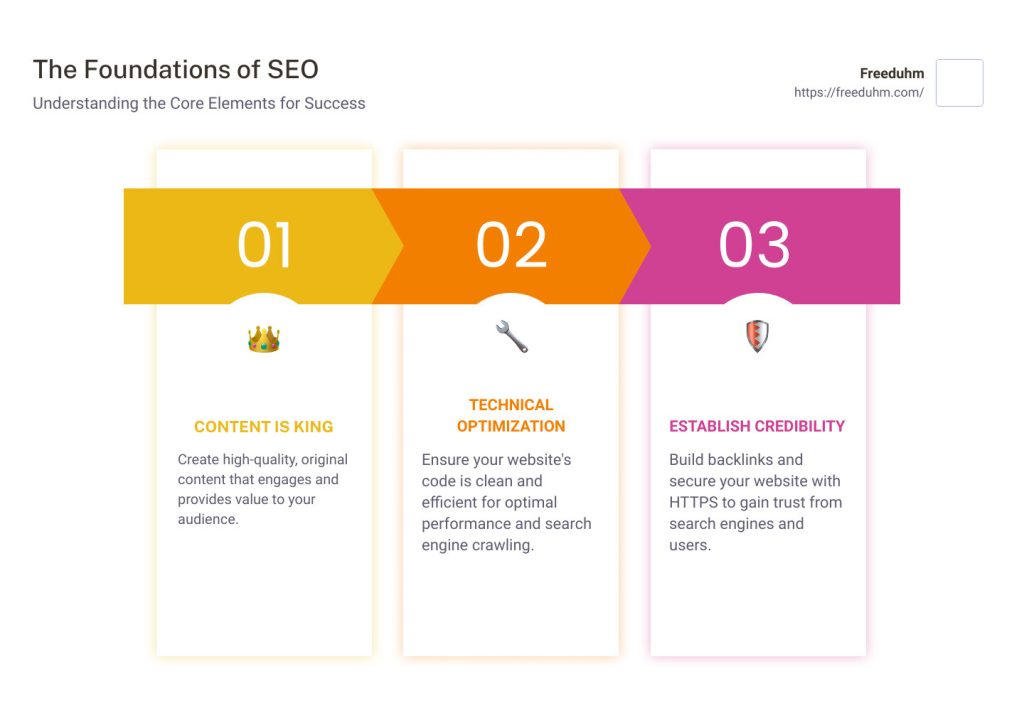
Understanding The 3 C’s Of SEO: Content, Code, And Credibility
The 3 C’s of SEO – Content, Code, and Credibility – are fundamental to any successful SEO strategy. These elements intertwine to form the blueprint of your website’s visibility and performance in search engine rankings.
Content: The Heart Of SEO
Content is the lifeblood of SEO. It’s about more than just filling your website with words – providing valuable, engaging, and unique information that satisfies the searcher’s intent. Content comes in many forms, including blog posts, product descriptions, images, videos, infographics, and more.
Your content should be high quality and relevant, answering the questions your audience is asking and offering solutions to their problems. It should also be unique, as Google appreciates originality and penalizes duplicate content. Regularly updating your content keeps it fresh and relevant, positively impacting your SEO.
Code: The Backbone Of SEO


Code is the technical aspect of SEO. It covers everything from your website’s speed and mobile-friendliness to its architecture and use of XML sitemaps. Essentially, it’s about optimizing the technical elements of your website to ensure search engines can crawl, index, and understand your site effectively.
This involves improving website speed by minimizing file sizes, leveraging browser caching, and reducing server response time. Your website must also be mobile-friendly, adapting and functioning seamlessly on various screen sizes. Additionally, a well-structured website architecture enhances user experience and improves search engine crawlability.
Credibility: The Trust Factor In SEO
Search engines are designed to provide users with the most relevant and high-quality results. That’s why credibility plays a crucial role in SEO. Credibility can be built through various strategies, such as earning high-quality backlinks from reputable sites and ensuring your website is secure with an SSL certificate (HTTPS).
The more credible your site is, the more likely search engines will rank it highly in search results. This improves your visibility and increases users’ trust in your brand and content.
In the following sections, we’ll delve deeper into each aspect, providing practical tips and strategies to optimize your SEO efforts.
Top 12 SEO Best Practices To Improve Rankings
As we dive into the strategies for optimizing your SEO, we’ll explore the top 12 best SEO practices to help your website achieve higher rankings in 2025.
1. Optimize Images For SEO To Get Additional Traffic
Images play a crucial role in enhancing the user experience on your site. However, it’s not enough to add images; you need to optimize them for SEO. This involves including relevant keywords and alt text in your image’s file name. A well-optimized image can boost your page’s ranking in Google web search.
2. Add Internal Links From Other Relevant Pages
Internal linking is a simple yet effective SEO practice. By linking one site page to another, you can guide visitors to more relevant content, increasing their time on your site. Additionally, internal links help Google understand the structure of your site, which can improve your site’s ranking.
3. Cover Everything Searchers Want To Know
High-quality content is a must for good SEO. But what is high-quality content? It’s content that answers all the questions a searcher might have. Be comprehensive in your content creation, ensuring you provide all the information your audience seeks.
4. Get More Backlinks To Build Authority
Backlinks, or links from other websites to your site, are a powerful way to build your site’s authority. They signal to search engines that your site is a reliable source of information. But remember, the quality of backlinks matters more than quantity. Strive to get backlinks from authoritative websites in your industry.
5. Get Good Scores To Pass Core Web Vitals
Google’s Core Web Vitals are a set of metrics that measure the speed, responsiveness, and visual stability of a web page. Achieving good scores on these metrics is crucial for improving your site’s ranking. Monitor your site’s performance and make necessary adjustments to ensure it passes Core Web Vitals.
6. Use HTTPS To Secure Your Site
Security is a top priority for both users and search engines. Using HTTPS (Hypertext Transfer Protocol Secure) helps protect your users’ sensitive information and boosts your site’s ranking in search results.
7. Maintain a Fast, Mobile-Friendly Website
With the shift towards mobile-first indexing, having a mobile-friendly website is no longer optional. Ensure your site loads quickly and displays correctly on all devices to provide a seamless user experience.
8. Target Long-Tail Keywords
Long-tail keywords, which are longer and more specific keyword phrases, can help you reach your target audience more effectively. They may have lower search volumes but often have higher conversion rates as they are more specific to what users seek.
9. Optimize Local Listings
Optimizing your local listings can improve your visibility in local search results if you have a local business. Ensure your business’s name, address, and phone number are consistent across all online platforms.
10. Create Helpful Content (And Optimize It For SEO)
Creating high-quality, helpful content is at the heart of SEO. But creating the content is only half the battle. It would be best to optimize it for SEO by using relevant keywords, adding meta descriptions, and structuring it for readability.
11. Re-Optimize Past Content
SEO is not a set-it-and-forget-it practice. Revisiting and re-optimizing your past content to ensure it remains relevant and valuable to your audience is essential.
12. Get On Google Discover
Google Discover is a new way for users to find content that aligns with their interests without a specific search. Getting your content on Google Discover can significantly increase your organic traffic.
Incorporating these best SEO practices into your strategy can significantly improve your website’s visibility and ranking. SEO is not a one-time event but a continuous process of optimizing your website for users and search engines. Stay tuned for more insights on aligning your content with user search intent and the importance of user experience in SEO.
The Role Of Search Intent In SEO Strategy
Understanding and aligning with user search intent is a crucial practice. It’s about knowing why users search for a particular topic and providing the most relevant answers. Let’s explore this further.
Aligning Your Content With User Search Intent
Search intent refers to why a user searches on Google or any other search engine. It’s the “why” behind each query. As Google’s primary job is to provide the best results for users’ search queries, aligning your content with search intent is one of the top SEO best practices.
For instance, if users search for “how to make a protein shake,” they’re likely looking for instructions or recipes, not products to buy. This is why we examine Google’s top results for a particular query to understand the intent behind it.
For example, imagine users searching for the “best eye cream.” As an eye cream retailer, you might think a product page would rank well for this keyword. But the search results tell a different story. Most results are blog posts listing top recommendations, not product pages. You should create similar content to increase your chances of ranking for this keyword.
Catering to search intent goes beyond creating a particular type of content. You also need to consider the content format and angle.
Using Keyword Research To Target Topics With Search Traffic Potential
Keyword research is the cornerstone of any successful SEO strategy. It involves identifying and analyzing people’s words and phrases when searching for information on a particular topic.
Start by identifying relevant topics for your business. This involves brainstorming ideas, researching industry trends, and studying competitor websites. Once you have a list of potential topics, delve deeper into the keywords related to these topics.
When selecting keywords, consider both the search volume and competition. Targeting keywords with high search volume and low competition is essential to increase your chances of ranking well.
Use various tools to analyze these keywords, providing insights into search volume, competition, and other metrics. This information helps determine which keywords will drive traffic to your site.
Finally, use these keywords to create optimized content for search engines. This includes optimizing titles, meta descriptions, and content for the selected keywords. This way, you ensure that your website is primed for search engines and that your content is more likely to be found by potential customers.
In conclusion, understanding and aligning your content with search intent and strategic keyword research are vital elements of effective SEO. By implementing these best SEO practices, you can ensure that your website is in the best position to attract and engage your target audience.
The Importance Of User Experience In SEO

“Digital Marketing team discussing the importance of User Experience.”
Regarding the best SEO practices, user experience (UX) holds a significant place. UX focuses on your website’s usability and how visitors interact with it. It’s a pivotal factor because if your website isn’t pleasant to use, visitors will promptly leave, generating a high bounce rate. This is something we always emphasize.
Improving Site User Experience To Reduce Bounce Rate
Reducing your bounce rate is a dual-benefit strategy. It not only improves your user experience but also boosts your SEO. Here are some strategies to help you achieve a lower bounce rate:
- Consistently update your content: Regularly updating your blog with fresh content keeps your audience engaged and encourages return visits.
- Optimize key pages: Strategically optimize the key pages on your website to improve user experience and achieve better results. Every element on your page, from the initial impression on your homepage to the seamless communication on your contact page, is crucial.
- Prioritize user needs: By focusing on user needs, delivering clear messaging, and establishing credibility, you can attract, engage, and convert potential clients effectively.
Monitoring And Improving Your Site’s Core Web Vitals
Google’s Core Web Vitals are a set of metrics designed to measure how users experience a page’s speed, responsiveness, and visual stability. To improve your website’s SEO, monitor and optimize these vitals.
To enhance your loading performance, consider compressing your images, minifying CSS, JavaScript, and HTML files, and using a Content Delivery Network (CDN). For rendering performance, optimize the critical rendering path, use efficient CSS selectors, and optimize JavaScript execution.
Don’t forget about responsiveness. Designing your site for various screen sizes and devices ensures a consistent and enjoyable user experience across different contexts.
Improving your site’s user experience is not a one-time task but a continuous process. Prioritizing UX and monitoring your site’s performance is key to staying ahead in the SEO game.
In the next section, we’ll discuss backlinks in SEO and how they can significantly enhance your website’s authority and ranking.
Backlinks In SEO
In SEO, backlinks often act as a seal of trust and recommendation. When a website links to your content, it’s vouching for your credibility and quality, signaling to search engines that your content is worth ranking. This is why building high-quality backlinks from authoritative websites and leveraging social media for content promotion and backlink generation is among the best SEO practices.
Building High-Quality Backlinks From Authoritative Websites
High-quality backlinks, particularly those from authoritative websites, can significantly boost your SEO performance. A study by SEMrush found a strong correlation between backlinks and higher Google rankings, emphasizing their importance even in 2025.
Creating link-worthy content is the first step. Our analysis at Freeduhm suggests that “what” and “why” posts and infographics tend to attract more backlinks. However, simply publishing these types of content does not guarantee backlinks. Your content must offer unique insights, original research, or a distinctive perspective that compels others to link to you.
Another effective strategy is to create content with a “hook” – a unique angle, data point, or controversial statement that sparks interest and encourages people to link to your content. For instance, a post on a strategy called “The Skyscraper Technique” attracted over 11.2K backlinks due to its detailed, step-by-step process and memorable name.
Utilizing Social Media For Content Promotion And Backlink Generation
Social media platforms can also significantly affect your backlink-building strategy. They offer a space to share your content, increase visibility, and potentially attract more backlinks.
To maximize the SEO benefit from social media, consider these best practices:
- Create Quality Content: Quality content is key to all SEO practices. Make sure your content is relevant and valuable to your target audience.
- Optimize Your Profiles: Include relevant keywords and phrases in your social media profiles to help search engines understand your content better.
- Share Content Regularly: Regularly posting content keeps your followers engaged and increases the chances of your content being seen by more people.
- Use Hashtags: Relevant hashtags can enhance the visibility of your content, making it easier for users to find and share your posts, potentially leading to more backlinks.
SEO is a long-term game. Consistency, patience, and continuous effort are key to achieving and maintaining high rankings in search engines. Focusing on these best SEO practices sets a strong foundation for your website’s SEO success in 2025 and beyond.
The Impact Of Technical SEO On Your Site’s Performance
As we dive deeper into the best SEO practices, we can’t ignore the indispensable role of technical SEO. This involves optimizing your website’s technical elements to enhance its visibility and performance in search engine rankings. By honing the technical aspects of your website, you can improve user experience, boost organic traffic, and bolster your overall SEO efforts. Let’s explore three critical areas of technical SEO: site speed, crawlability and indexability, and structured data.
Improving Site Speed For Better User Experience And SEO
A swift-loading website can significantly enrich your user experience and positively influence your search engine rankings. There are several tactics to amp up your website speed:
- Use a Content Delivery Network (CDN): CDNs replicate essential resources like images across a global network of servers, ensuring that resources load locally for users, thereby reducing latency.
- Compress images: Compressing images decreases the file size, leading to faster load times. However, always balance size with quality.
- Implement lazy-loading: This tactic defers the loading of offscreen resources until they are needed, enabling the browser to be usable before all images on a page have loaded.
- Choose an optimized theme: Select a website theme with efficient code. You can check its optimization level by running the theme demo through Google’s Pagespeed Insights tool.
Ensuring Crawlability And Indexability Of Your Site
Ensuring your website is crawlable and indexable by search engines is a non-negotiable part of technical SEO. This means checking for crawl errors, fixing broken links, and using tools like robots.txt testing and XML sitemap submission to facilitate the crawling and indexing. When your website is easily accessible and understandable to search engines, it can achieve higher rankings.
Implementing Structured Data For Enhanced SERP Visibility
Structured data, also known as Schema Markup, provides additional context to search engines about your website’s content. It helps search engines understand various content types, such as products, events, and reviews. Implementing schema markup can enhance your search engine visibility and enable rich results, like star ratings and product information, in search engine listings.
We believe you can significantly improve your website’s performance by focusing on these technical SEO best practices, leading to higher search rankings and increased organic traffic. As you evolve your SEO strategy, remember that technical SEO is a fundamental component that shouldn’t be overlooked. The following section will explore the future of SEO best practices in 2025 and beyond.
Wrapping Up
As we look ahead to 2025, SEO best practices continue to evolve, with a greater emphasis on user experience, high-quality content, and technical optimization. The future of SEO is not just about keywords and backlinks but about understanding and meeting user expectations, creating a seamless and enjoyable online experience, and ensuring your website is technically sound and easily accessible to search engines.
User Experience is at the heart of future SEO practices. Websites that prioritize user experience by creating a fast, mobile-friendly platform will be rewarded with higher rankings. Google’s Core Web Vitals, which measure vital aspects of user experience, will continue to play a significant role in SEO rankings.
High-quality Content remains king in the SEO game. From optimizing images and targeting long-tail keywords to re-optimizing past content, creating valuable, relevant, optimized content is more crucial than ever. The future of SEO will prioritize content that covers everything users want to know, providing comprehensive answers to their queries.
Technical Aspects of SEO will also be paramount. Search engines are becoming more innovative, and the technical health of your website is essential. HTTPS security, site speed, crawlability, and indexability will remain critical to SEO best practices.
The future of SEO is not a one-size-fits-all strategy. It requires a comprehensive, well-planned approach that combines content, credibility, and code – the 3 C’s of SEO. This includes everything from the relevance and quality of your content to the user-friendliness and technical soundness of your website.
We understand the importance of staying ahead of the curve in the ever-evolving world of SEO. We’re committed to helping businesses navigate these changes and implement the best SEO practices to improve their online visibility, reach their target audience, and boost their bottom line.
As we continue to explore digital marketing and its trends, we encourage you to join us on this journey. Check out our posts on business trends for 2023 and beyond, outbound marketing, and competitive marketing. To dive deeper into a more technical side, explore our resources on web application development and tech startups.
SEO is not a one-time task but a long-term commitment. By staying updated with the best SEO practices and implementing them effectively, you can ensure your website stays relevant, user-friendly, and visible in the digital landscape. We hope this guide has provided valuable insights into the best SEO practices for 2025. Here’s to your success in SEO!


