



Are you unsure about the impact of your billboard advertising? Do you wonder about the efficiency of your out-of-home marketing campaigns? Understanding how to measure billboard effectiveness is crucial in today’s dynamic marketplace. By tracking your billboard’s performance, you can gain invaluable insights into your campaign’s reach, audience engagement, and overall return on investment (ROI). This knowledge can transform your advertising strategy, ensuring your marketing dollars are well spent.
We understand the challenges that come with measuring billboard success. Unlike digital ads, billboards don’t provide immediate click-through rates or conversion metrics. However, leveraging a combination of traditional and innovative measurement methods makes it possible to gauge the impact of your billboard advertising reliably and effectively.
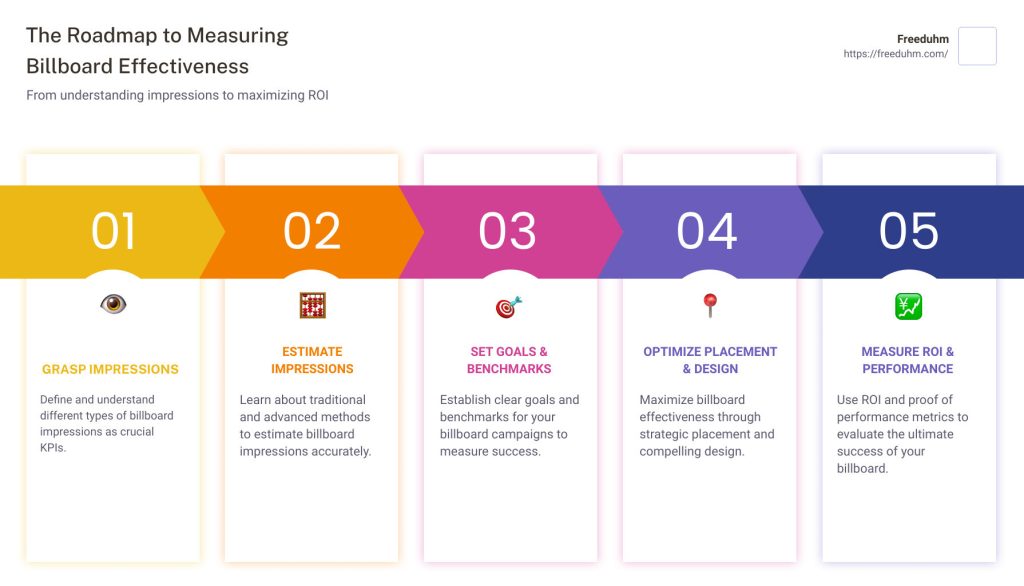
Here’s a quick glimpse of what we’ll cover:
- Understanding Billboard Impressions as a Key Performance Indicator.
- Methods to Estimate Billboard Impressions.
- Setting Goals and Benchmarks for Billboard Impressions.
- Maximizing Billboard Impressions through Strategic Placement and Design.
- Integrating Billboard Campaign with Other Marketing Channels.
- Measuring Billboard ROI and Proof of Performance.

Let’s uncover how billboards can effectively contribute to your overall marketing mix and how you can accurately measure their impact.
Understanding Billboard Impressions as a Key Performance Indicator
In billboard advertising, impressions serve as a vital metric to understand the reach of your ad. But before we dive deeper, let’s start by defining what we mean by billboard impressions.
Defining Billboard Impressions: Actual Views vs Potential Views
Billboard impressions refer to the number of times people see your billboard advertisement. There are two types of views to consider: actual and potential. Real views occur when someone sees your ad while passing by the billboard. On the other hand, possible views appear when someone could have seen your ad but didn’t, for example, if they weren’t looking at the road. The total number of views is then divided by 1,000 to create a metric called “thousands of impressions” or “KPIs.”
Why Do Billboard Impressions Matter? Reach And Opportunities
Understanding billboard impressions is crucial because it provides insight into how many people your ad is reaching and how many opportunities potential customers can see it. Not only does this help you gauge the overall success of your advertising campaign, but it also allows you to identify areas for improvement and optimization. Tracking billboard impressions can also help you compare your efforts to industry benchmarks and see how your campaign stacks up against competitors. This valuable insight can guide you in improving your advertising strategy and staying ahead of the competition.
Factors Affecting Billboard Impressions: Location, Placement, And Audience Demographics
Several factors can affect the number of impressions your billboard garners. For instance, the location of your billboard plays a significant role. If your billboard is strategically placed in an area with high traffic, it’s likely to have a higher number of impressions than if it’s located in a less busy area. Similarly, placement near popular tourist attractions can boost impressions compared to placements in residential areas.
Understanding your target audience’s demographics and daily patterns can also help improve impressions. For example, placing billboards along transit routes can increase visibility if your target audience frequently uses public transportation.
Impressions serve as a vital KPI in measuring billboard effectiveness. By comprehending impressions, why they matter, and the factors that affect them, you can make more informed decisions to improve your billboard campaign’s success. Up next, we’ll explore various methods to estimate billboard impressions.
Methods To Estimate Billboard Impressions
One of the first steps in understanding how to measure billboard effectiveness is determining the number of impressions. There are several methods available, each with its unique features and challenges. Let’s explore how these methods can contribute to your billboard’s performance.
Traditional Methods For Estimating Impressions
Traditionally, billboard impressions were estimated by counting the number of vehicles passing the billboard daily and multiplying this by the average number of passengers per vehicle. This method provides a basic estimate of how many people might have seen your billboard each day. Yet, it has limitations, such as not accounting for repeat viewers and assuming all passengers can see the billboard, which isn’t always the case.
Using Technology In Measuring Impressions
Thanks to technology, measuring billboard impressions has become more precise and nuanced. For instance, GPS tracking can monitor the movement of mobile devices, providing data on the number of people who pass by a billboard. Another exciting development is computer vision technology, which uses cameras and machine learning algorithms to detect and track the movement of vehicles and pedestrians.
These technologies offer a more accurate estimate of impressions by accounting for traffic patterns, weather, and time of day. As we embrace digital transformation, expect even more innovative methods to emerge for measuring billboard impressions.
Challenges In Accuracy Of Billboard Impressions
While technology has made it easier to measure billboard impressions, challenges remain. Data accuracy can be affected by several factors, including the billboard’s location, size, and orientation. For instance, a billboard in a high-traffic area during rush hour would likely generate more impressions than one in a less populated place. Similarly, a billboard near a popular tourist destination could generate higher impressions than one in a residential area.
Therefore, while impressions are crucial in assessing billboard effectiveness, they must be interpreted in context. Understanding these variables can help you decide where to place your billboards and how best to design them for maximum visibility.
Traditional methods and technology provide valuable ways of estimating billboard impressions. However, be aware of the limitations and challenges that can affect the accuracy of these measurements. Leverage these methods to ensure your billboards reach their maximum potential and effectively communicate your message to your target audience.
The following section will discuss setting goals and benchmarks for billboard impressions, an essential aspect of any successful advertising campaign.
Setting Goals And Benchmarks for Billboard Impressions
Importance Of Setting Goals For Billboard Campaigns
Setting clear, measurable goals is critical in any marketing strategy, and billboard advertising is no exception. Establishing goals at the onset of a billboard campaign helps to provide a clear direction and purpose. It can shape your campaign’s design, location, and overall strategy.
The goals you set for your billboard campaign may vary depending on your business objectives. For instance, you may aim to increase brand awareness, launch a new product, or promote a specific event. Whatever your goals, they need to be SMART: Specific, Measurable, Achievable, Relevant, and Time-bound. This framework ensures your goals are clear, trackable, and tied to your business objectives.
How Do You Set Effective Benchmarks For Billboard Impressions?
Once you’ve established your goals, the next step is setting benchmarks. Benchmarks are reference points against which you can measure your campaign’s performance and effectiveness.
For billboard impressions, a key benchmark could be the number of potential and actual views you aim to receive. You can derive this figure by considering factors such as the location of your billboard, the amount of traffic in that area, and the demographics of the audience you’re trying to reach.
You should also consider industry benchmarks. For instance, according to the Out of Home Advertising Association of America, OOH advertising methods—including billboards—are between 38% and 86% effective at provoking a consumer response. This information can help you set realistic expectations for your campaign.
Another way to set benchmarks is by using historical data. If you’ve run billboard campaigns in the past, you can use the results from those campaigns to set benchmarks for your new one.
Setting goals and benchmarks is not a one-time task. It’s an ongoing process that requires regular review and adjustment as you gather data from your campaign.
In the following sections, we’ll discuss maximizing billboard impressions through strategic placement and design and integrating your billboard campaign with other marketing channels.
Maximizing Billboard Impressions Through Strategic Placement And Design
Measuring billboard effectiveness is about tracking impressions and making strategic decisions to maximize these impressions. Two crucial factors to consider are the placement and design of your billboard.
Importance Of Billboard Placement In High Traffic Areas


Location, location, location! The mantra holds in billboard advertising just as much as in real estate. A billboard placed in a high-traffic area is predisposed to generate more impressions due to the sheer volume of potential viewers passing by. This could be on busy highways, near popular tourist destinations, or in areas with heavy foot traffic.
When choosing a location for your billboard, it is crucial to consider your target audience’s demographics and daily patterns. For example, if your audience includes daily mass transit commuters but live in the suburbs, diversifying billboard placements along their daily routes and local roads where they run errands can optimize exposure.
You might also want to place your billboard on the same side of the road as your business to maximize local exposure. This can help to reinforce your brand and increase the likelihood of foot traffic to your business.
Role Of Visibility And Eye-Catching Design In Billboard Effectiveness
Once you’ve chosen a strategic location, the next step is creating an attention-grabbing design. The design and messaging of your billboard should be clear, concise, and memorable. Use bold colors, simple fonts, and imagery that attracts attention. Your audience will only have a few seconds to read your message, so make it count.
Visibility is another crucial factor in your billboard’s effectiveness. Your billboard should be visible from a distance and stand out. This might mean choosing an elevated location or placing your billboard in a well-lit area.
Your billboard design should also convey your brand’s unique selling proposition clearly and succinctly. Use your billboard to communicate key messages that resonate with your target audience. These could be your business’s main benefits or what sets you apart from your competitors.
Maximizing billboard impressions requires careful planning and execution. Choosing a strategic location and designing an eye-catching ad can generate significant images and drive traffic to your business.
In the next section, we will discuss how you can amplify the reach of your billboard campaign through integration with other marketing channels.
Integrating Billboard Campaign with Other Marketing Channels
Integrating your campaign with other marketing channels is one of the most effective ways to measure billboard effectiveness. This approach enables you to compound your reach, engage with your audience on multiple platforms, and gather more data for analysis.
Amplifying Billboard Reach Through Social Media Engagement
Social media platforms have become powerful tools for amplifying the reach of your billboard advertising. By incorporating elements like hashtags, QR codes, or website URLs on your billboard, you can encourage viewers to engage with your brand online.
For instance, you could include a call to action on your billboard, prompting viewers to like your social media pages or share a picture of your billboard for a chance to win a prize. This strategy increases engagement and provides a way to track the interactions and impressions generated by your billboard.
Monitor your social media platforms for mentions, shares, and discussion about your billboard campaign. Increased engagement and brand mentions can provide valuable insights into the billboard’s impact on brand awareness.
Using Sales Analytics To Measure Billboard Impact
Consider adding Sales Analytics into your arsenal for measuring billboard effectiveness. By tracking sales and conversions during and after the billboard campaign, you can gauge the impact of your billboard on your bottom line.
For example, if you see a noticeable uptick in sales or conversions during the campaign period, it could be attributed to the billboard’s influence. Similarly, tracking website traffic, especially to a specific landing page or unique URL mentioned on the billboard, can help you measure the engagement and interest generated by your ad.
Metrics like customer acquisition cost (CAC), average order value (AOV), and customer lifetime value (CLV) can provide insights into the efficiency and long-term impact of your billboard advertising efforts. A well-strategized and executed billboard campaign can attract more customers at a lower acquisition cost, influence higher spending, and foster long-term customer relationships.
Integrating your billboard campaign with other marketing channels and leveraging sales analytics can provide a more holistic and accurate measure of billboard effectiveness. In the next section, we’ll explore how to measure billboard ROI and proof of performance to ensure your campaign delivers the desired results.
Measuring Billboard ROI And Proof Of Performance
Understanding ROI In Billboard Advertising
Return on Investment (ROI) is a crucial metric in any marketing campaign, and billboard advertising is no exception. However, measuring the ROI of a billboard campaign can be slightly more complex due to the indirect nature of the advertising medium.
Typically, the ROI is calculated by comparing the costs associated with the billboard campaign to the revenue generated. This includes advertising expenses, production costs, and personnel costs. By comparing these costs to the increase in sales revenue or customer value during and after the campaign, we can estimate the ROI.
Remember that a billboard campaign often complements other marketing channels, and its influence may be seen in the overall marketing mix rather than direct conversions. For instance, a surge in website traffic or social media engagement during the campaign could indicate the billboard’s effectiveness. Thus, a comprehensive approach to measuring ROI is recommended, considering both the direct and indirect impacts of the campaign.
What is Proof Of Performance In Billboard Advertising, And How Do We Measure It?
Proof of Performance (POP) in billboard advertising is an essential report confirming that your ad was displayed per the agreement. POP typically includes the vendor name, structure number, the advertiser’s name, flight dates, products advertised, and ad photos displayed on the billboard structure.
Measuring POP has become more accurate and efficient. With technology, advertisers can get real-time data on when and how often their ads are played and geolocation data to estimate the potential audience reach. By analyzing this data, you can measure the performance of individual billboards and make strategic decisions for future campaigns.
Understanding how to measure billboard effectiveness is crucial for maximizing ROI and ensuring your campaign’s success. By using a combination of traditional and modern methods, we can gain a comprehensive understanding of billboard performance and its impact on your overall marketing efforts.
The Value Of Billboards As An Effective Advertising Tool

As we’ve explored, billboard advertising remains a necessary avenue in the marketing mix. Its effectiveness lies in reaching a large audience and creating lasting brand impressions. Despite the rise of digital marketing, the billboard’s physical presence in the public space gives it a unique edge, making it an advertising medium that shouldn’t be overlooked.
Unlike digital ads, which can be skipped or blocked, billboards offer the audience a constant and consistent message. The ability to generate a high number of impressions, especially when placed in high-traffic areas, makes it valuable for raising brand awareness and visibility.
However, the value of billboards as an effective advertising method is not just about their reach. It’s about understanding and measuring its impact on your audience. As we’ve discussed, strategic placement, eye-catching design, and integrating your billboard campaign with other marketing channels can significantly enhance your campaign’s effectiveness.
Technology has made it possible to measure billboard impressions and provide valuable insights accurately. Tools such as geolocation data and QR codes have made the once daunting task of measuring billboard effectiveness more manageable and precise. This allows us to make data-driven decisions and continuously improve our marketing strategies.
But remember, the impact of a billboard is not always immediate. It’s about creating a lasting impact and a strong brand recall. A well-executed billboard campaign can continue to generate benefits long after its run, contributing to long-term brand recognition and customer loyalty.
We encourage you to harness billboards in your marketing strategy and see the impact for yourself. By understanding how to measure billboard effectiveness, setting clear goals, and using the right metrics, you can optimize your billboard advertising for maximum impact and ROI.
Want to dive deeper into marketing and learn more about other effective advertising tools? Check out our comprehensive resources on various marketing strategies, and stay ahead. For a deeper understanding of outbound marketing, including billboard advertising, visit our detailed guide on outbound marketing.
Effective advertising is reaching the right people at the right time and place. And billboards, when done right, do just that.


