




Introduction
Are you feeling overwhelmed by the multitude of digital marketing tools available today? You’re not alone. Over the years, marketing has undergone a dramatic transformation, primarily driven by technological advancements. This has led to the creation of many digital tools that serve diverse marketing functions. The trouble is finding the right software, which can feel like searching for a needle in a haystack. Our comparison of digital marketing tools aims to ease this confusion and help you make data-driven decisions that propel your marketing efforts forward.
Brief Overview Of Digital Marketing Tools
From content creation to campaign automation and analytics, digital marketing tools envelop a broad spectrum of functionalities. They aid in designing compelling social media posts, bring accuracy to SEO efforts, streamline email marketing, and provide valuable insights through advanced analytics. These tools are designed to bolster your marketing strategy and give your business an edge in the competitive digital realm.
Importance Of Digital Marketing Tools In Modern Business
In today’s digitized world, businesses looking to remain competitive cannot afford to ignore the power of digital marketing. The potential reach is vast, the insights are powerful, and the growth potential is extensive. However, charting a clear digital marketing course requires the support of robust digital tools. Why is that? These tools provide efficiency, accuracy, and scalability that manual processes cannot match.
Factors To Consider When Choosing Digital Marketing Tools
When comparing digital marketing tools, it’s crucial to consider your business’s needs and size, your team’s experience level, and your budget. What are the features you want in a tool? What key performance indicators (KPIs) are you hoping to track? Would your team require training to use this tool, or is it user-friendly? Answering these questions can help streamline the selection process and ensure you choose a tool that aligns with your business needs.
Quick Snapshot: Top Digital Marketing Tools Compared
| Tool | Main Functionality | Best for |
|---|---|---|
| SEMrush | SEO and Analytics | Business with robust SEO needs |
| HubSpot | CRM & Email Marketing | Medium to large businesses |
| MailChimp | Email Marketing | Small to Mid-size businesses |
| Canva | Graphics Design | Businesses needing quick graphic designs |
| Google Analytics | Web Analytics | Any size of business interested in web analytics |

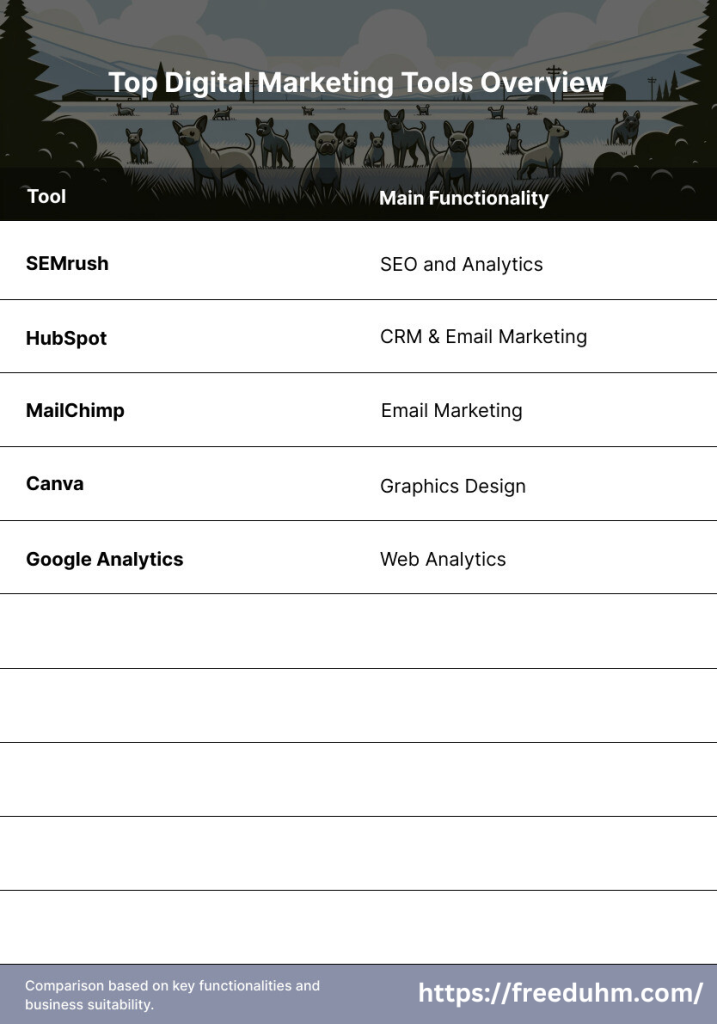
Stay tuned as we delve deeper into each tool in the subsequent sections, mulling its features, pros and cons, and ideal user base. Find out which tool could be the linchpin your digital marketing strategy needs.
Understanding Different Types Of Digital Marketing Tools
To make an informed comparison of digital marketing tools, it’s crucial to understand the different types of tools available and their respective functions. Let’s explore them in detail.
Website And Social Media Graphics Tools
Visual content plays a significant role in digital marketing strategy. Tools like Canva provide an easy-to-use platform for creating engaging graphics for websites and social media channels. At the same time, Unsplash offers a vast array of free, high-quality stock photos to enhance your content.
Photo Editing Tools
Photo editing tools are essential for refining images to align with the brand’s aesthetic. Tools like Adobe Photoshop provide comprehensive features for professional photo editing, while platforms like Pixlr offer AI-powered photo editing for beginners.
Social Media Management Tools
Managing multiple social media platforms can be overwhelming. Social media management tools like Sprout Social and Hootsuite allow businesses to schedule posts, monitor engagement, and analyze performance across different platforms from a single dashboard.
Presentation And Webinar Tools
Presentations and webinars are valuable for sharing information and engaging with audiences. Tools like Google Slides and Zoom provide platforms for creating interactive presentations and hosting webinars.
Video Creation And Hosting Tools
Video content is increasingly popular in digital marketing. Platforms like Animoto offer easy video creation, while YouTube and Vimeo provide hosting services for sharing and embedding videos on websites.
E-commerce Website Builders
For businesses selling products online, E-commerce website builders like Shopify and WooCommerce offer platforms for creating user-friendly online stores, managing inventory, and processing transactions.
Landing Page Builders
Creating optimized landing pages is crucial for driving conversions. Tools like Unbounce and Leadpages allow businesses to build and test effective landing pages.
Keyword Research Platforms
Keyword research is a fundamental aspect of SEO focused on digital marketing. Platforms like SEMrush and Ahrefs provide comprehensive keyword research tools that give insights into search volume, keyword difficulty, and organic competition.
AI Chatbots And Chatbot Builders
AI chatbots enhance customer service by providing instant responses to customer queries. Platforms like MobileMonkey and Drift offer tools for building and integrating AI chatbots on websites.
Forms And Surveys Tools
Forms and surveys are invaluable for gathering customer feedback and data. Tools like Google Forms and Typeform make creating customized forms and surveys easy.
AI-Powered Content Writing And Editing Tools
AI-powered content writing and editing tools like Grammarly and ProWritingAid help improve written content quality by detecting grammatical errors and suggesting improvements.
Email Marketing Software
Email marketing software like Mailchimp and ActiveCampaign allows businesses to create targeted email campaigns, automate workflows, and track performance metrics.
CRM And Lead Management Apps
CRM and lead management apps like HubSpot and Zoho CRM Plus aid businesses in managing customer relationships and track leads. These tools provide an overview of customer interactions, helping to streamline sales and marketing efforts.
Marketing Automation Apps
Marketing automation apps like Marketo and Omnisend streamline repetitive marketing tasks like email campaigns and social media posting, saving businesses valuable time and resources.
Our next section will delve deeper into a detailed comparison of these tools, outlining their features, pricing, and ideal use cases. This will help you make a more informed decision in comparing digital marketing tools.
Top Digital Marketing Tools Comparison
Before you decide on the tools that best suit your business needs, it’s crucial to understand what each tool offers and how it can benefit your digital marketing efforts. Here, we’ll provide a comprehensive comparison of some of the top digital marketing tools in the industry.
1. SEMrush: SEO And Marketing Analytics
SEMrush is a staple SEO tool many businesses use to track their keyword rankings and explore new terms to rank for. The tool offers a breakdown of keyword ideas, difficulty, and variations, which are excellent for brainstorming content ideas and identifying search intent. It’s a fantastic competitive analysis tool that ensures your existing content is optimized for search.
2. HubSpot: CRM, Email Marketing, And Automation
HubSpot is a comprehensive platform that combines CRM, email marketing, and automation. It’s beneficial for businesses that want to streamline their marketing efforts and keep everything under one roof. From managing customer relationships to automating your email marketing campaigns, HubSpot offers a range of tools to help you enhance your digital marketing strategy.
3. MailChimp: Email Marketing And Automation
MailChimp is a user-friendly tool designed to make email marketing easy and affordable, even for those just starting to build their email list. With features like codeless campaigns, simple automation, and easy-to-read reporting, MailChimp can help you manage and optimize your email campaigns.
4. Canva: Graphic Design And Content Creation
When creating stunning visuals for your digital marketing campaigns, Canva is the go-to tool. It’s perfect for businesses that need to create high-quality graphics but don’t have a dedicated design team. Canva offers a range of templates and design elements to make the process as straightforward as possible.
5. Google Analytics: Website And Marketing Analytics
Google Analytics is a free tool that provides detailed insights into your website’s performance. It allows you to track key metrics like website traffic, user behavior, and conversion rates, which are crucial for making data-driven decisions in your marketing strategy.
6. Sprout Social: Social Media Management And Analytics
Managing multiple social media channels can be daunting, but with Sprout Social, you can keep everything organized in one place. Sprout Social allows you to schedule posts, engage with your audience, and analyze your social media performance.
7. OptiMonk: Conversion Optimization And Popup Builder
OptiMonk is a tool that specializes in conversion optimization. It allows you to create and test different website versions to see which performs best. OptiMonk also offers a popup builder feature that can help you capture leads and increase conversions.
8. Omnisend: E-commerce Marketing Automation
Omnisend is an E-commerce marketing automation platform designed to help online stores build strong customer relationships. It allows you to automate your marketing processes, from sending personalized emails to setting up automated workflows.
9. Marketo: Lead Management And Marketing Automation
Marketo is a powerful marketing automation platform that offers a range of tools for lead management, email marketing, and campaign management. It’s designed to help businesses streamline their marketing processes and improve conversion rates.
10. Ahrefs: SEO And Keyword Research
Ahrefs is another powerful SEO tool that provides detailed insights into your website’s search performance. It allows you to explore your site’s top organic keywords, check your competitors’ traffic, and identify your top-performing content.
11. OptinMonster: Lead Generation And Conversion Optimization
OptinMonster is a lead generation tool that focuses on conversion optimization. It allows you to create attractive opt-in forms and popups to capture leads and turn them into customers.
12. Constant Contact: Email Marketing And Contact Management
Constant Contact is an email marketing tool designed to help small businesses grow. It provides a range of features, including email automation, contact management, and reporting tools.
13. Moosend: Email Marketing And Automation
Moosend offers a surprisingly robust email solution for those just beginning to build their list. The platform includes features such as codeless campaigns, simple automation, and easy-to-read reporting.
14. Optimizely: Digital Experience Optimization
Optimizely is a platform that combines tools for visual creation and audience targeting to run tests on different segments of your audience quickly. It’s an excellent tool for fine-tuning your site for optimal performance.
15. Unbounce: Landing Page Builder And Conversion Platform
Unbounce allows you to quickly build, tweak, and publish new landing pages to test. It offers built-in A/B testing and variant analytics to determine which elements of your landing pages are working and which aren’t.
16. Venngage: Infographics And Visual Content Creation
Venngage is a tool that allows you to create engaging infographics and visual content for your marketing campaigns. It’s easy to use and offers a variety of templates to get you started.
17. Hootsuite: Social Media Management And Scheduling
Hootsuite is a social media management tool that allows you to schedule posts, engage with your audience, and analyze your social media performance from one dashboard.
As you can see, each tool has its strengths and unique features, but the choice ultimately depends on your specific business needs and goals. In the next section, we’ll dive into the role of automation in digital marketing and how tools like Zapier can help streamline your marketing tasks.
The Role Of Automation In Digital Marketing
In digital marketing, efficiency is critical. We live in an era where businesses constantly seek ways to streamline processes, improve productivity, and save time. That’s where automation comes into play.
Importance Of Automation In Digital Marketing
Automation in digital marketing is not just a nice-to-have feature; it’s a must-have. It allows businesses to automate repetitive tasks, saving significant time and reducing the risk of human error. Think of it as having a virtual assistant that handles mundane tasks so you can focus on strategic, high-value activities.
For instance, automation can help streamline customer service processes, enabling businesses to respond to customer inquiries more quickly and accurately. Moreover, it can efficiently manage and scale your outbound marketing initiatives, such as automated email campaigns, lead nurturing, and customer segmentation processes.
Another crucial aspect of automation is its role in analytics and measurement. With automation, you can track key metrics such as click-through rates, conversion rates, customer acquisition costs, and return on investment (ROI). These insights can be invaluable in refining your strategies, optimizing campaigns, and allocating resources more effectively.
Using Zapier To Automate Digital Marketing Tasks
One of the tools that can help you automate your digital marketing tasks is Zapier. This tool allows you to connect your business-critical apps with other tools your team uses most—like form builders and meeting schedulers—so you can streamline your processes and quickly scale your efforts.
For instance, if you’re using an email marketing tool like MailChimp and a CRM like HubSpot, Zapier can help you automatically add new MailChimp subscribers to your HubSpot CRM. This way, you’re not manually transferring data from one platform to another, and your teams can always access updated information.
In summary, automation is not just an accessory in the digital marketing toolkit; it’s the engine that drives efficiency and productivity. Incorporating automation into your digital marketing strategy can free up time for strategic thinking, improve your campaign performance, and ultimately drive better business results. In the next section, we’ll guide you through choosing the best digital marketing tools that align with your business needs and budget.
How Do You Choose The Best Digital Marketing Tools For Your Business?
Regarding comparing digital marketing tools, it’s not just about listing the best tools available. You also need to align them with your specific business needs, budget, and your team’s expertise. Let’s break this down into three key areas that you should consider.
Assessing Your Business Needs And Budget
It is essential to define your business needs clearly regarding digital marketing. Are you looking to strengthen your social media presence, improve SEO, or automate email marketing? Each tool specializes in different areas, so identifying your core needs will help narrow your options.
Once you’ve outlined your needs, set a realistic budget. While some tools may seem expensive, they could offer features that bring value and ROI in the long term. For instance, Google Ads might initially appear costly, but it’s a tool that can drive significant traffic to your website, leading to potential conversions.
Evaluating The Features And Capabilities of Different Tools
Next, dive deep into the feature sets of each tool. For instance, Canva is an excellent tool for creating visually compelling social media posts, while Trello is great for content management and planning. Look for features that specifically address your business needs and help you achieve your marketing goals.
In addition, consider the tool’s reporting and analytics capabilities. These will provide insights into your campaign’s performance and guide future marketing decisions. A tool like Google Analytics, which offers comprehensive reporting and customization, could be valuable to your toolkit.
Considering The Size And Experience Level Of Your Team
Finally, keep in mind the size and skill level of your team. Some digital marketing tools require a steep learning curve and might not be ideal if you have a small team, or your team members are not tech-savvy. On the other hand, user-friendly tools like Canva and Trello can be quickly learned and implemented by just about anyone, regardless of their design or technical background.
At Freeduhm, we understand that choosing the right digital marketing tools can seem daunting. But with careful planning and evaluation, you can select tools that will meet your business needs and enhance your team’s productivity and efficiency. The ultimate goal is to create a robust digital marketing strategy that brings you closer to your customers and drives business growth.
Wrapping Up
Recap Of The Best Digital Marketing Tools
In our comprehensive digital marketing tools comparison, we’ve explored a range of tools across various categories. These include SEMrush and Ahrefs for SEO and marketing analytics, HubSpot and Marketo for CRM, automation, and lead management, MailChimp and Moosend for email marketing, Canva and Venngage for graphic design, and Google Analytics and Oribi for website and marketing analytics, to name a few.
Each tool has its unique strengths and capabilities. For instance, HubSpot offers an all-in-one solution for managing digital marketing activities and leads, but it might not be the best choice if you’re only planning to use some of its features due to its cost. On the other hand, Oribi helps by providing actionable insights on multiple attributes, making it an all-in-one tool for marketing analytics suitable for businesses of all sizes.


Final Thoughts On Choosing The Right Tools For Your Business
Choosing the right tools for your digital marketing strategy depends on your budget, team size, and experience level. Considering and aligning these aspects with the features and capabilities of the tools you’re considering is essential.
There’s no one-size-fits-all answer in digital marketing. The best tool is the one that fits your specific needs and helps you achieve your business objectives. Whether improving your SEO, managing your social media, creating engaging content, or analyzing your marketing efforts, the right tool can significantly enhance your digital marketing strategy.
At Freeduhm, we understand how critical it is to stay updated with the latest digital marketing trends and tools. We encourage you to explore other resources on our website, such as our articles on Digital Marketing and Search Engine Marketing, to enhance your digital knowledge further.
With a suitable set of digital marketing tools and a solid strategy, you can confidently navigate the dynamic digital marketing landscape, making informed, data-driven decisions that drive your business growth.


