



Are you struggling to nail down effective marketing strategies for your business? Feel overwhelmed by buzzwords like ‘b2b’ and ‘b2c’ and wonder how these concepts apply to your marketing efforts. You’re not alone. Understanding key concepts such as b2b and b2c marketing strategies can seem daunting in a dynamic business landscape filled with acronyms and jargon. But don’t worry; we’re here to decode these for you.
At ‘Freeduhm,’ we passionately believe in the power of clarity. By intentionally simplifying complex concepts like b2b and b2c marketing strategies, we empower professionals like you to make informed decisions, implement effective strategies, and drive business growth. This guide aims to demystify b2b and b2c marketing and provide a concrete roadmap that addresses your needs.
Here’s a quick look at what you need to understand when it comes to b2b and b2c marketing:
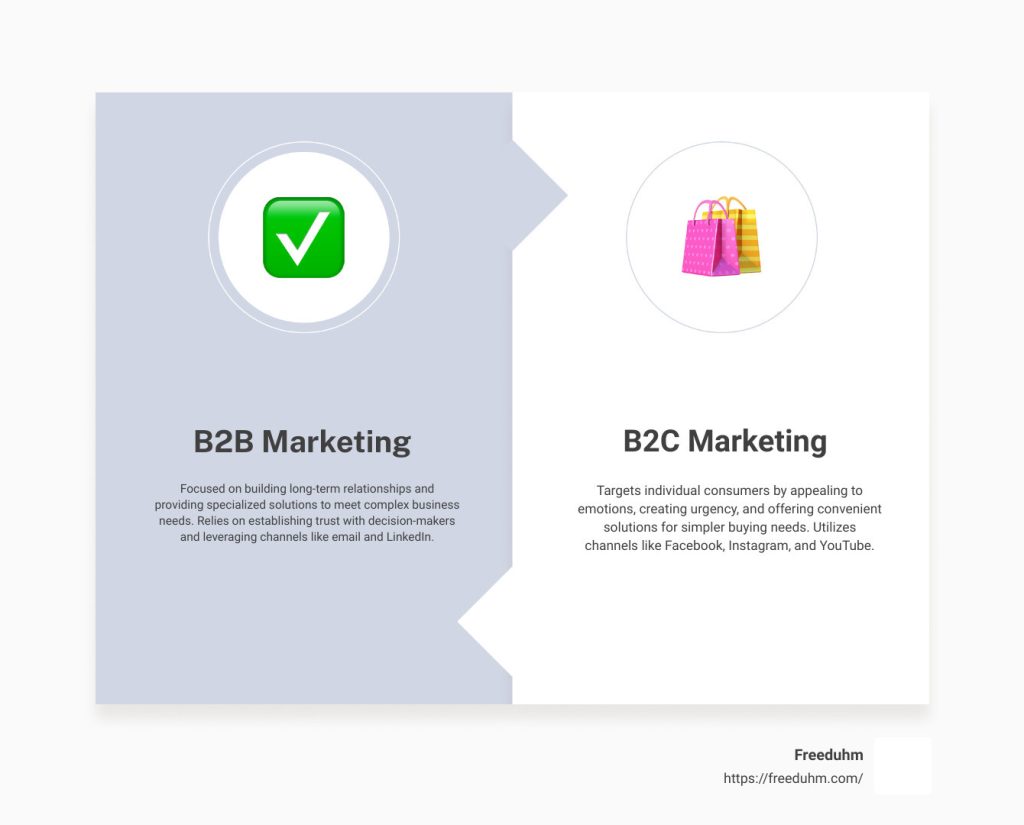
- B2B (Business-to-Business) Marketing involves forming long-lasting relationships, providing value-packed solutions for more complex needs, and emphasizing credibility and expertise.
- B2C (Business-to-Consumer) Marketing focuses on appealing to individual consumers’ emotions, creating urgency, and offering convenient solutions for relatively more straightforward buying needs.
Successfully navigating the marketing realm lies in comprehending these differences, tweaking your strategies accordingly, and making your message resonate with the right audience.

Understanding B2B And B2C Marketing
Before we dive into the intricacies of B2B and B2C marketing strategies, let’s understand the basic definitions and critical differences between these two types of marketing.
What is B2B Marketing?
B2B, or business-to-business marketing, refers to the marketing strategies or content specifically designed for businesses or organizations. In other words, if your company sells products or services to other businesses, you primarily use B2B marketing strategies.
B2B marketing involves understanding the needs of other businesses and tailoring your marketing strategy to meet those needs. This specialized form of marketing often focuses on building long-term relationships with clients rather than trying to make a quick sale.
An emphasis on complex data also characterizes B2B marketing, return on investment (ROI), and other factual evidence supporting the value of your offerings.
What is B2C Marketing?
On the other hand, B2C, or business-to-consumer marketing, targets individual consumers. If your company sells products or services directly to consumers, you primarily use B2C marketing strategies.
B2C marketing is often characterized by creating a sense of urgency and encouraging impulse purchases. It aims to appeal to consumers’ emotions and personal benefits. B2C marketers often use compelling narratives and emotive language to connect with their audience personally.
For example, a bicycle company selling a $200 bicycle to a consumer might evoke joy and excitement, making the purchase an enjoyable experience for the buyer.
B2B vs B2C: Key Differences
The main difference between B2B and B2C marketing lies in who the intended audience of the marketing efforts is. B2B marketing targets businesses, while B2C marketing targets individual consumers. As such, the strategies and tactics used in each can be quite different.
In B2B marketing, you typically deal with more complex decision-making processes involving multiple stakeholders. The sales cycle can be longer, and the emphasis is usually on building relationships and demonstrating ROI.
In contrast, B2C marketing often deals with simpler buying processes, typically just one person making the purchase decision. The sales cycle may be shorter, and the emphasis is on creating an appealing, easy-to-understand offer.
However, it’s important to note that despite these differences, both B2B and B2C marketing share common goals: to attract attention, generate interest, and convert that interest into sales.
Whether dealing with B2B or B2C marketing, understanding your target audience and their needs is vital to creating effective marketing strategies. At Freeduhm, we can help you navigate the complexities of B2B and B2C marketing to reach your target customers successfully.
In the following sections, we’ll delve deeper into the specific strategies and tactics that can be used in B2B and B2C marketing.
B2B Marketing Strategies: Building Relationships And Trust
Understanding the nuance of B2B marketing strategies is essential for any business aiming to sell its products or services to other businesses. The focus of B2B marketing pivots heavily towards long-term relationships, specialized solutions, establishing trust, content creation, and dealing with the challenges that come with it.
The Importance Of Long-Term Relationships In B2B Marketing
In B2B, building solid and long-term relationships with clients is critical. Unlike B2C, where consumers often make quick, impulse purchases, B2B transactions require significant time and resources. Therefore, fostering a solid relationship with your clients can lead to repeat business and referrals, which is critical for sustainable growth.
Specialized Solutions: Catering To Business Needs
Each business has its unique set of challenges and needs. Therefore, providing specialized solutions tailored to the specific needs of your clients is vital in B2B marketing. Understanding their pain points and offering solutions can set your business apart. At Freeduhm, we emphasize the importance of innovation and adaptability in creating these specialized solutions.
Establishing Trust With Decision-Makers And Stakeholders
Trust is a cornerstone in B2B marketing. Establishing credibility and reliability with decision-makers and stakeholders in the companies you are targeting is crucial. This trust can be built through transparency, consistency, and delivering on your promises. Gaining the trust of your B2B clients can lead to long-term partnerships and growth for your business.
The Role Of Content In B2B Marketing
Content plays a significant role in B2B marketing. It’s not just about selling your products or services; it’s about providing valuable information to help your clients make informed decisions. This might involve creating blog posts, videos, infographics, and webinars relevant to your industry and client’s needs. Creating high-quality content can help establish your brand as a thought leader, increase brand awareness, and improve customer engagement.
Challenges In B2B Marketing: Content Creation And Time Constraints
Despite its importance, content creation can also be one of the significant challenges in B2B marketing. Creating content that resonates with your clients and provides value requires substantial time, resources, and expertise. Additionally, given the long sales cycles in B2B, marketers often face time constraints in generating leads and closing deals.
However, with careful planning, execution, and continuous learning, you can develop B2B marketing strategies that deliver results. The key is to keep your client at the center of your marketing efforts and provide solutions that meet their needs.
B2B Marketing Tactics: From Awareness To Retention
Nailing down the right tactics for B2B marketing is critical for achieving your business goals. A successful B2B marketing approach involves guiding potential customers from the stage of awareness to the retention stage.
The B2B Sales Funnel Explained
The B2B sales funnel is more complex and extensive than its B2C counterpart. It often involves multiple stages: awareness, consideration, decision, and retention. This process usually involves extended efforts such as networking and building relationships before making a sale.
B2B decision-makers are typically more risk-averse, requiring more information, verification, and guarantees before purchasing. The sales cycle for B2B enterprises can take months, even years, involving multiple rounds of negotiation, meetings, and evaluations. The most successful B2B sales teams have mastered the art of relationship building, persuasion, and providing a personalized consumer experience.
Effective Channels For B2B Marketing: Email And LinkedIn
When it comes to effective channels for B2B marketing, email marketing, and LinkedIn stand out. Email marketing allows for personalized communication and is an excellent tool for nurturing leads and building relationships. On the other hand, LinkedIn, being a professional networking platform, is ideal for targeting decision-makers and key stakeholders in various industries.
In addition, content marketing is also a powerful tool for B2B marketing. Creating valuable and relevant content helps establish your business as a trusted industry expert and thought leader. This can involve creating blog posts, videos, infographics, and webinars that provide solutions to the challenges faced by your target audience. At Freeduhm, we’ve found that a well-executed content strategy can significantly improve customer engagement and build strong relationships.
Key Metrics In B2B Marketing: Lead Quality, Conversion Rate, And Customer Lifetime Value
To measure the success of your B2B marketing strategies, track key metrics. These include the quality of leads generated, the conversion rate from leads to customers, and the lifetime value of a customer.
The quality of leads indicates how well your campaigns generate interest in your products or services. The conversion rate gives insight into how successful your campaigns are at converting leads into paying customers. Lastly, the customer’s lifetime value helps you understand the long-term value of your customers and the return on investment from your campaigns.
By tracking these metrics, you can gain valuable insights into the success of your B2B marketing efforts and make informed decisions about future strategies. At Freeduhm, understanding these metrics is crucial for successful B2B marketing.
Ultimately, whether you focus on B2B or B2C marketing, the key is understanding your audience, building relationships, and consistently delivering value.
B2C Marketing Strategies: Evoking Emotions And Creating Urgency
The Power Of Emotion In B2C Marketing
When it comes to B2C marketing strategies, emotion plays a significant role. Unlike B2B customers who base their decisions on business impact, B2C customers are more inclined towards emotionally driven purchases. An uplifting story about someone who benefited from the product can be all the persuasion they need. As blog.hubspot.com states, “People buy with their hearts more often than their minds.”
In our experience at Freeduhm, building an emotional bond with your audience can lead to stronger brand recall and loyalty. We use emotional branding and storytelling techniques to establish this bond, allowing us to resonate with our audience more deeply.
Crafting Persuasive Narratives For Consumers
Creating persuasive narratives for consumers is a crucial strategy in B2C marketing. The power of a well-told story cannot be overstated. By weaving relatable and authentic stories, brands create a sense of empathy and understanding. These stories humanize the brand and make it more relatable, contributing to its brand salience.
At Freeduhm, we understand the importance of storytelling and incorporate it into our B2C marketing strategies. We share narratives that resonate with our audience’s experiences and values, creating a solid emotional connection that leaves a lasting impact.
Showcasing Direct Benefits And Experiences
B2C customers are highly invested in their enjoyment when buying for themselves. They are more interested in fun, direct benefits, and experiences than the average B2B audience. Therefore, showcasing how your product or service can enhance their lives and provide them an enjoyable experience is essential.
At Freeduhm, we create engaging content that captures our audience’s attention, generates buzz, and inspires action.
The Role Of Content In B2C Marketing
Content in B2C marketing needs to be entertaining and engaging. This could include videos, stories, reviews, and social media posts designed to capture attention and generate excitement. As noted by Tom Lloyd, “Most purchase decisions, even in B2B, are made emotionally,” reinforcing the need for emotionally resonant content for your B2C audience.
At Freeduhm, we leverage a variety of content types to engage our B2C audience. From blog posts and videos to social media campaigns, we strive to create content that resonates with our audience and encourages them to take action.
Challenges In B2C Marketing: Limited Advertising Budgets
One of the significant challenges in B2C marketing is limited advertising budgets. Unlike B2B marketers who struggle with content creation and time constraints, B2C marketers often wish for a bigger advertising budget to spread the word about their products.
Despite these challenges, there are cost-effective ways to reach your B2C audience. At Freeduhm, we recommend strategies like organic social media marketing, influencer partnerships, and user-generated content to maximize reach without breaking the bank.
In conclusion, B2C marketing strategies require a different approach than B2B strategies. By understanding the power of emotion, crafting persuasive narratives, showcasing direct benefits, creating engaging content, and overcoming budget limitations, you can build effective B2C marketing strategies that resonate with your audience and drive results.
B2C Marketing Tactics: From Awareness To Loyalty
Now that we’ve covered the key strategies for B2C marketing let’s delve into the tactics that can help a business move its customers from simple awareness to loyal brand advocates.
The B2C Sales Funnel Explained
In contrast to B2B, the B2C sales funnel is typically shorter and more straightforward. It starts with awareness, where potential customers learn about the product or service. This is often driven by digital marketing strategies that raise brand visibility, such as social media advertising or search engine optimization (SEO).
Next comes interest, where potential customers begin to engage with the brand. This could involve visiting the website, following the brand on social media, or signing up for a newsletter.
The decision stage comes next, where potential customers weigh their options and decide whether to purchase. At this stage, persuasive messaging and promotional offers can be highly effective.
The final stage, action, involves the actual purchase. Making this process as seamless and convenient as possible is crucial. This can be achieved by offering various payment methods and ensuring a smooth checkout.
Effective Channels For B2C Marketing: Facebook, Instagram, And YouTube
Facebook, Instagram, and YouTube are leading channels for B2C marketing, allowing brands to reach large audiences with engaging content.
Facebook ads can be highly targeted based on user demographics and interests, making it an effective platform for reaching your ideal customers.
With its visual focus, Instagram is perfect for showcasing products and lifestyle content. It’s particularly effective for businesses with visually appealing products or services.
YouTube is an excellent platform for video content, ranging from product demonstrations to customer testimonials. Our B2C Marketing guide highlights that video content can drive conversions and help build a connection with your audience.
Key Metrics In B2C Marketing: Reach, Engagement, And Customer Satisfaction
There are several key metrics to consider to measure the success of your B2C marketing efforts.
Reach measures the number of people who have seen your content, indicating brand awareness.
Engagement measures how people interact with your content – likes, shares, comments, or clicks. High engagement strongly indicates that your content is resonating with your audience.
Finally, ‘customer satisfaction’ is a critical metric gauged through reviews, ratings, and direct customer feedback. High customer satisfaction can lead to repeat purchases and word-of-mouth referrals, which are invaluable in B2C marketing.
In summary, B2C marketing tactics involve understanding and utilizing the sales funnel, leveraging effective marketing channels, and monitoring key performance metrics. By implementing these tactics, businesses can build a strong B2C marketing strategy that fosters customer loyalty and drives growth.
The Intersection Of B2B And B2C Marketing Strategies
Despite their differences, B2B and B2C marketing strategies share certain core principles. Both require a deep understanding of the target audience and a focus on creating valuable customer experiences. Let’s delve into these shared principles in more detail.
The Role Of Personalization In Both B2B and B2C Marketing
While personalization plays a different role in B2B and B2C marketing, it’s critical in both contexts. As we’ve pointed out, B2B marketing requires a higher level of personalization due to its diverse and niche target audience. Each message and offer must be tailored to different buyer personas, industries, and journey stages.
On the other hand, in B2C marketing, even though the audience is broader, personalization is still essential. B2C marketers must create messages and offers that resonate with a large audience. Still, they also need to consider niche opportunities, adjacencies, and profitable sub-segments that can be addressed with tailored messaging and outreach.
Therefore, personalization should be a key consideration whether you’re crafting a B2B or B2C marketing strategy. This involves collecting and analyzing customer data, using CRM for B2B marketing, and social media analytics for B2C marketing.
Emotional Appeal: A Common Thread In B2B And B2C Marketing
Another commonality between B2B and B2C marketing strategies is emotional appeal. As mentioned earlier, B2C purchases are often emotionally driven. However, B2B buyers, despite needing to consider the business impact, are not devoid of emotions. A well-told brand story or a compelling value proposition can influence their decision-making process.
The key is to strike the right balance. While B2C marketing tends toward entertainment, B2B marketing focuses on educating the audience. But in both cases, creating a connection with the audience on an emotional level can significantly enhance the effectiveness of your marketing efforts.
The Shift Towards Person-To-Person (P2P) Marketing
Despite the differences in B2B and B2C marketing strategies, it’s essential to remember that at the end of the day, all marketing is P2P – person to person. Whether marketing to a business or a consumer, you communicate with individuals. Recognizing this can help create more authentic and effective marketing strategies.
This shift towards P2P marketing emphasizes the importance of personal branding in both B2B and B2C contexts. As business professionals, we should promote our products or services and build our brands. This can involve humanizing your brand with video, showcasing your values, and being authentic.
In conclusion, while B2B and B2C marketing strategies differ in many ways, they share some fundamental principles. Understanding these shared principles allows you to create more effective and impactful marketing strategies regardless of your target audience.
Choosing The Right Marketing Strategy For Your Business
There is no one-size-fits-all answer when deciding between B2B and B2C marketing strategies. The ideal strategy will depend on your specific business, industry, and target audience. Below are three key considerations to consider when choosing your marketing strategy.
1. Understanding Your Target Audience
Understanding your target audience is the first step in crafting an effective marketing strategy. In B2B marketing, your audience is other businesses, often with complex needs and multiple decision-makers. In B2C marketing, your audience is individual consumers, typically driven by emotional triggers and convenience. As Tom Lloyd rightly pointed out, “Most purchase decisions, even in B2B, are made emotionally and then post-rationalized using all those lovely case studies and ROI metrics.” By understanding your audience’s unique needs and decision-making processes, you can tailor your strategies to resonate with them.
2. Aligning Your Marketing Strategy with Business Goals
Next, ensure your marketing strategy aligns with your overall business goals. Whether you want to increase brand awareness, generate qualified leads, or boost customer loyalty, your marketing efforts should help drive these objectives. As suggested, developing a content archive can be a helpful way to repurpose valuable content and align your marketing efforts with your business goals.
3. The Importance Of Continuous Learning and Adaptation In Marketing
Finally, remember that marketing is an ever-evolving field. The most successful marketing strategies adapt and evolve with changing market conditions. Stay up-to-date with the latest trends, monitor your competition, and continuously analyze your performance. This will allow you to make necessary adjustments and ensure your marketing strategy remains effective.


Whether you’re a B2B or B2C marketer, your strategies should aim to build trust, provide value, and meet the unique needs of your audience. By focusing on these principles, you can create impactful B2B and B2C marketing strategies that drive results.
Check out our in-depth Digital Marketing and Inbound Marketing guides for more insights on marketing strategies. If you’re interested in learning more about how to adapt your business model to changing market conditions, our Business Model guide can be a great resource. At Freeduhm, we’re committed to helping you stay ahead in the ever-evolving world of digital marketing.


