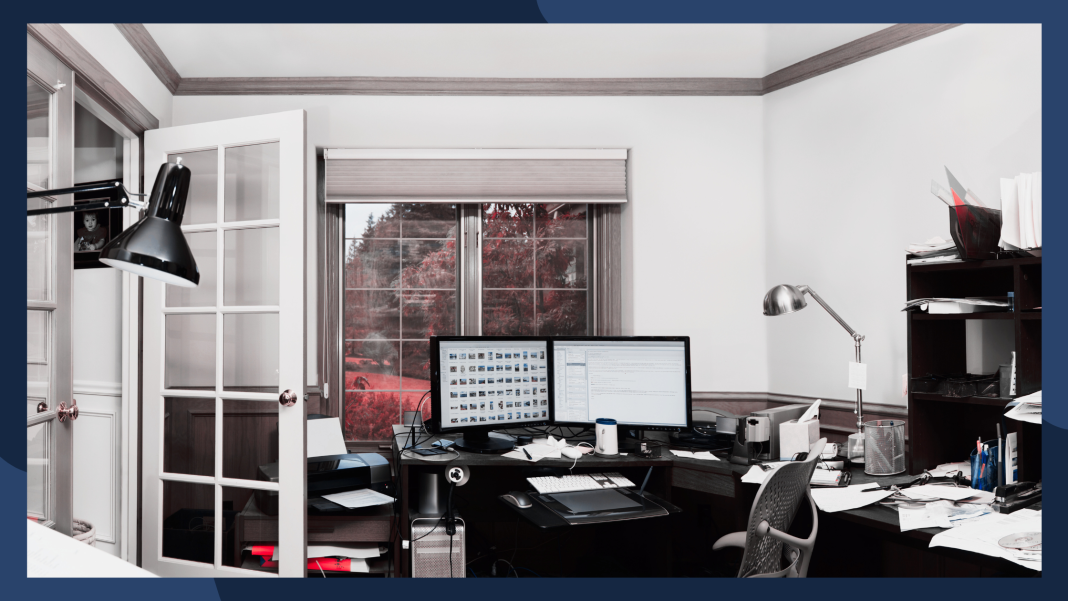
We sought to enhance productivity with a home office setup and turned to top executives and micro-business owners. Discover these professionals ‘ top four recommendations, from improving acoustics with soundproofing to creating multiple task-specific work areas.
1. Improve Acoustics With SoundProofing
An area that is often overlooked is the acoustics of a room. Having excellent acoustics in a space makes it easier to relax and focus on the job you are required to do.
Direct Fabrics has found that with more people working from home and needing quiet spaces, they have begun investing in soundproof curtains and blinds. These are used both for absorption to improve the acoustics of a space and to deaden the sound and insulate a space if it is next to a busy road. Having a space that allows for minimal disruption increases productivity. Also, having a space that is appealing in decoration means you will naturally be more comfortable in the space.

Edward Simon, Director, Direct Fabrics
2. Invest In Ergonomic Furniture And Tech
I’ve worked from home for years and have learned a thing or two about designing an adequate environment. Investing in ergonomic furniture is the first step toward a productive home office setting. A height-adjustable workstation and a comfortable chair can significantly boost comfort and efficiency. High-speed internet is also essential, especially for micro-business owners who rely on online collaboration tools.
Another critical step is to upgrade your laptop. A gadget that allows you to multitask and supports operating system upgrades can significantly impact your productivity. When selecting a computer, consider size, portability, RAM space, battery life, storage, and the number of USB ports. Using the proper color schemes and vegetation to design your area can help boost your motivation and efficiency. Provide for storage and a meeting space. These proposals can be implemented in stages. Begin with the necessities, such as a comfortable chair, a functional desk, and reliable internet.
As your budget allows, gradually incorporate vegetation and color palettes. Remember, the idea is to create an environment where you feel at ease and can work productively. I hope this information was helpful to you.

James Smith, Owner, Travel-Lingual
3. Dedicate And Optimize Your Workspace
Invest in a dedicated workspace—carve out a zone solely for work, even in limited space. Optimize lighting with natural sources, reducing eye strain and enhancing focus.
For micro-business owners, cost-effective solutions abound: repurpose existing furniture, utilize affordable ergonomic accessories, and leverage online marketplaces for budget-friendly buys. Establish a routine mimicking office hours to delineate work and personal time. Incorporate simple productivity tools and project management apps to streamline tasks.
By creating a purposeful workspace without breaking the bank and adhering to a structured routine, micro-business owners can cultivate a home office that fuels efficiency and productivity.

Himanshu Sharma, CEO and Founder of Academy Of Digital Marketing
4. Create Multiple Task-Specific Work Areas
Having one designated work location in your home office is a fast way to become unproductive. The environment becomes stale rather quickly. I recommend you have a work environment for each of your primary tasks so that you feel a different energy at each location.
My home office includes an outdoor space for creative writing, a standing desk with a treadmill for meetings, and a traditional office desk setup for day-to-day responsibilities. I recommend this strategy to every micro-business owner.

Jason Vaught, President, 805 SEO