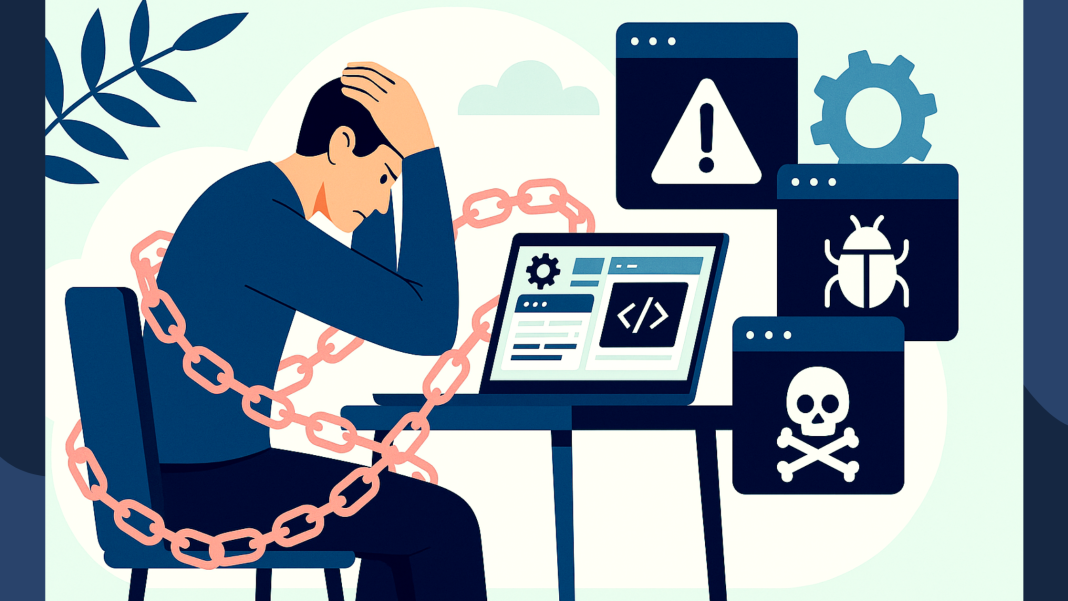
Low-code platforms have gained popularity for their promise of rapid development, but they come with potential long-term risks. Let’s examine five critical dangers of overreliance on these low-code platforms. Understanding these challenges is crucial for organizations considering or already using low-code solutions.
1. Low-Code Platforms Create Fragmented Tech Ecosystems
One long-term danger of overusing low-code platforms is creating a fragmented, inflexible technology ecosystem that becomes difficult and expensive to maintain or scale over time. While low-code tools are fantastic for rapid prototyping and empowering non-technical staff to build solutions quickly, they often encourage a patchwork approach to solving problems. This can lead to “shadow IT,” where vital business processes and data are managed outside the oversight of your IT team or established governance protocols.
This becomes even riskier for law firms and other highly regulated industries. If you rely heavily on low-code platforms, you may inadvertently sidestep crucial compliance, data security, and accessibility standards baked into custom-developed solutions. Additionally, as your firm grows or your needs change, you may find that these low-code apps can’t scale or integrate smoothly with your other platforms, creating operational bottlenecks.
Another significant risk is vendor lock-in. Many low-code platforms use proprietary frameworks, meaning the more you build with them, the harder it becomes to migrate your data and processes if you decide to switch platforms or need custom functionality that the original tool can’t support.
Ultimately, while low-code tools undoubtedly speed up development and offer short-term cost savings, overdependence can hamper long-term flexibility, control, and compliance, key factors for any law firm that wants to maintain a competitive edge and safeguard client trust. Using low-code platforms strategically is best, balancing rapid development with long-term IT strategy and oversight.

Jason Bland, Co-Founder, Custom Legal Marketing
2. Hidden Technical Debt Limits Future Scalability
One long-term danger of overusing low-code platforms is the hidden buildup of technical debt that only reveals itself when it’s too late to pivot easily. While low-code tools offer speed and accessibility, they often create an illusion of scalability until your business logic becomes too complex, performance issues surface, or you hit a customization wall that the platform was never built to handle. I’ve seen teams move fast with low-code, only to realize a year later they’ve boxed themselves into a rigid ecosystem, reliant on proprietary syntax, undocumented workflows, and a patchwork of integrations that make migration a nightmare.
This is particularly risky because these limitations typically emerge when your product or team has matured, when you’re ready to scale, not experiment. At that point, replatforming or rebuilding in custom code is costly, disruptive, and can burn precious momentum. That’s not to say low-code doesn’t have a place; it does, especially for rapid prototyping or internal tools. However, treating it as a permanent foundation without long-term architectural thinking is like building a skyscraper on a sandbox.
The key is balance. Use low-code to accelerate, but always keep an eye on exit strategies, data portability, and how maintainable your systems will be if (and when) your technical demands outgrow the tool. Short-term wins shouldn’t cost you long-term agility.

John Mac, Serial Entrepreneur, UNIBATT
3. False Sense Of Technical Independence Emerges
One of the long-term dangers I’ve seen with overusing low-code platforms is creating a false sense of technical independence. They let non-developers build apps or automate workflows quickly, which is excellent for productivity. However, organizations lean too heavily on these tools over time without understanding the underlying logic or limitations. I’ve seen cases where a company builds an entire ecosystem on a low-code solution only to hit a wall when they need complex customizations or face performance issues that the platform wasn’t designed to handle.
This can lead to a kind of “technical debt in disguise”. Because it feels easy and efficient upfront, teams often neglect documentation, scalability, or proper data architecture. Later, companies become locked into a vendor or forced to do costly rewrites when the platform can’t support growth or integrate with new systems. In my experience, the healthiest approach is to treat low-code as a complementary tool, not a universal fix. It works best with technical oversight and a long-term strategy anticipating future complexity. Otherwise, short-term speed can quietly compromise long-term resilience.

Sovic Chakrabarti, Director, Icy Tales
4. Abstraction Masks Long-Term Architectural Challenges
One long-term risk is technical debt hidden behind convenience. Low-code platforms often abstract too much, making quick wins easy but masking scalability or customization limits. Over time, teams hit a wall when trying to integrate with more complex systems, manage performance, or version-control logic. The platform’s constraints start dictating architecture instead of the other way around. A better long-term approach is treating low-code as a layer for rapid prototyping or internal tools, while keeping core systems flexible and developer-driven where performance and control matter.

Vipul Mehta, Co-Founder & CTO, WeblineGlobal
5. Black Box Systems Hinder Maintenance
One long-term danger of overusing low-code platforms is creating systems that no one truly understands beneath the surface. I witnessed this firsthand at a company where a marketing operations team built an entire lead-routing workflow in a low-code CRM builder. It worked fine until they needed a custom exception for a new region. No team member could explain how the logic flowed, and when we brought in a developer to help, it took days to untangle the visual rules and hidden dependencies. What saved time upfront turned into a maintenance headache.
The core issue wasn’t the tool but the overreliance on abstraction. When teams lean too heavily on low-code without documenting logic or involving technical stakeholders, they build black boxes. When those break or need to scale, the cost isn’t just technical debt; it’s business disruption. I’m not anti-low-code, but I always recommend treating it like any other tool: with version control, documentation, and a plan for when complexity eventually outgrows the interface.

Matt Mayo, Owner, Diamond IT
Hidden Price Of Convenience
While low-code platforms offer a compelling shortcut to rapid deployment and cost savings, their long-term overuse presents a series of trade-offs that forward-thinking organizations cannot ignore. What begins as a solution for agility can quietly evolve into a web of technical, architectural, and strategic dependencies. From vendor lock-in and limited customisability to stifled innovation and mounting integration challenges, these platforms may eventually inhibit the agility they promise.
I believe the key is not to reject low-code altogether, but to approach it with a balanced strategy. Organizations should treat low-code as a tactical tool within a broader digital transformation roadmap, not as a blanket solution. A mature governance framework, apparent architectural oversight, and continuous investment in internal development capability are essential safeguards against long-term risks. The question isn’t whether low-code is “good” or “bad” but whether its use is aligned with the organisation’s long-term vision, adaptability, and technical autonomy. In the race for digital acceleration, convenience should never come at the expense of control.