




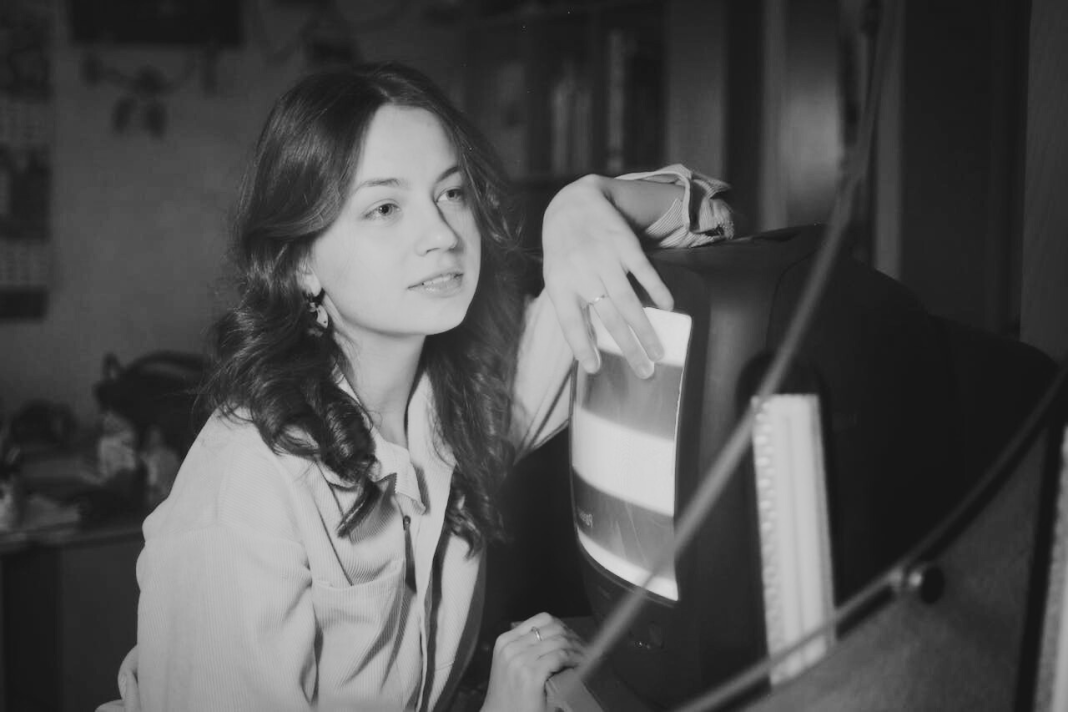
“Television” is not an object — it’s not a box, or a panel, with a screen. It’s a technology that’s evolved constantly since its origin, and it’s still evolving. A recent study of television watching habits found that 85% of Generation Z watches TV on their mobile phone. But like so many amazing innovations that changed our lives, television has a history, and it’s worth revisiting. The development of television is packed with lessons and reminders on how technology develops, changes, and changes again.
Television was not invented by one or two scientists or mechanics, and its development went through a number of stages over time. But before its emergence, there was never anything like it — a form of telecommunications that transmits moving images and sound, a mass medium that delivers stories, truths, advertising, news and sports, and now a streaming platform. So how did it get started?
We begin in the 1880s, far earlier than most people might think, and there was a lot of trial and error. To transmit images was a mystery that drive many different minds. Two different kinds of approaches marked this early history — mechanical and electronic, with some pivotal intersection points and milestones.
First let’s look at mechanical systems: In 1884 the Nipkow spinning disk had a spiral pattern of holes, with each hole scanning a line of the image. Then came a device with 64 selenium cells that served as an electronic “retina,” with mirrors and a display screen. This could transmit individual letters of the alphabet. Then came another step forward, from 1906 to 1911: a Nipkow disk was combined with a cathode ray tube (CRT). That was the first working mechanical TV system.
By 1921, a mechanical TV system designed by John Logie Baird, a Scottish inventor and electrical engineer, made the first public transmission of moving images. It was shown at Selfridge’s department store in London. Baird also labored over concepts for color television and a video recording device, but he was too far ahead of his time and couldn’t bring these ideas to light.
But the images transmitted in these early days were strange — nothing like today’s images. Around the same time, another approach took fruit, which was electronic systems — another instance of a pivot to a new strategy that furthered television’s evolution. In England, an inventor named J.J. Thomson used a cathode ray tube (CRT) as a display device, inspiring scientists in England, Germany, and Russia to spend the next decade using CRTs to transmit and receive images. Then in 1926 a Japanese inventor, Kenjiro Takanajagi, demonstrated a TV system with a forty-line resolution on a CRT display, and a fully electronic television receiver.
Just as a reminder, that was nearly a full century ago, and progress continued. Over the next three years, Phil Farnsworth at Westinghouse Electric demonstrated a completely electronic television system to create and show images. RCA (the Radio Corporation of America) had been working on a similar system. But the U.S. patent office stated that Farnsworth had priority. He was awarded a million dollars for his role.
Other systems were developed in Germany, Russian, Holland, and the U.S. But it was clear that standards needed to be agreed to — and by 1949, they did. That’s when the technology started taking off, with the advent of the first television sets: big, bulky, and with circuits built with vacuum tubes. After transistors were invented by Bell Laboratories, they took the place of the vacuum tubes — and Sony released the first fully transistorized television in Japan in 1960.
You could say the rest is history, but there’s more — innovation spurs innovation, and color was on people’s minds. It had been since the late 1880s, actually, but no one could find the practical answer to the question of how. Back to John Baird: in 1928, he did develop a color system, but a cumbersome one. It entailed three apertures with filters of different primary colors, three light sources, and was scanned to a projection screen.
In 1940 and 1941, CBS and RCA conducted field tests in 1940-1941 on color television sets, but they were not compatible with black and white television. In 1954 live color television finally became a reality — and by 1972, color sets outsold black and white sets.
But the technology that dominates the production of television displays today is something else: OLED, or organic light-emitting diode. Images are represented by pixels, the smallest addressable element in a dot matrix display device. The number of pixels determines the degree of representation of the original, or the resolution. You’ve likely experienced high-resolution TV, which entails hundreds or thousands of pixels per inch, so detailed it’s almost scary. Usually colors are represented by three or four-color components, such as red, green and blue.
The screens for OLED technology are extremely thin: some 2-3 millimeters, if, indeed viewers use a screen. They could also use their laptops, their tablets, and as mentioned before, their smartphones. The advent of smart television has shifted our viewing habits from traditional broadcasts to streaming, from having to wait for weekly episodes to being able to binge-watch entire seasons in a night. But one thing remains: we love television. Whatever iteration it takes as it continues to evolve, it’s likely to remain a part of our lives.
Please check my new book Reflecting On History: How the Industrial Revolution Created Our Way Of Life.


