



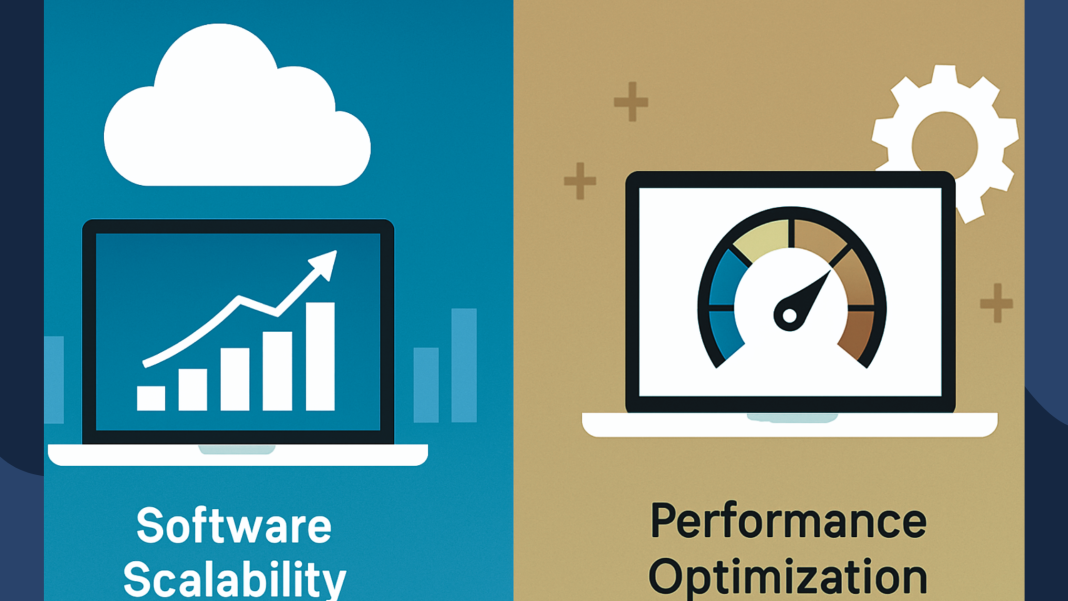
Software development often involves crucial decisions about system architecture. Understanding scalability and performance optimization is essential for creating robust applications. We explore the apparent differences between these two concepts to provide a clear and comprehensive comparison.
1. Focus On Growth vs Speed
The primary distinction between software scalability and performance optimization lies in their focus and approach. Performance improvements aim to speed up and make a system efficient in carrying out its tasks while eliminating latency, increasing throughput, or maximizing resource utilization in the existing infrastructure. Popular performance enhancement techniques include improving algorithms, caching, and query optimization so the system operates faster with its current load.
On the contrary, scalability concerns the system’s ability to tackle growing demand depending on the vertical or horizontal resources. It guarantees that the system scales as the user load grows while maintaining performance. The adjustments, such as microservices, load balancing, and distributed databases, may be rather architectural. Performance optimization is about speed enhancement on a fixed setting, while scalability helps the system grow easily under higher loads.


Dhari Alabdulhadi, CTO & Founder, Ubuy Peru
2. Preparing For Future vs Present Demands
One of the key differences between scalability and performance optimization is what they prepare the system for. Scalability is about how well your software handles growth, more users, more data, and more demand, without breaking. Performance optimization makes the software faster or more efficient under its current load. I think performance is tuning a car engine to run smoother and quicker. Scalability asks, “What happens when I put five more people in the car and try to drive up a mountain?” You can have blazing-fast performance for one user, but that doesn’t mean your app won’t crawl when 10,000 log in simultaneously.
In practice, I’ve worked on systems where performance tweaks, such as caching here and query optimization there, made things snappy, but when usage spiked, things broke anyway because we hadn’t designed for scale. That’s when we had to rethink load balancing, database sharding, or moving to microservices. So, while performance makes things better now, scalability ensures things don’t worsen later. Both matter, but they solve different problems.


Sovic Chakrabarti, Director, Icy Tales
3. Handling Increased Load vs Optimizing Current
One key difference between scalability and performance optimization is that scalability is about handling more, while performance is about doing it faster. I learned this the hard way during a product update. We optimized our database queries to speed up load times (performance), but our system still buckled when traffic spiked during a campaign. That’s when we realized we hadn’t built for scale. We had to restructure parts of our backend to handle concurrent users more efficiently, including load balancing and decoupling services. Now, I treat performance like tuning a race car for speed and scalability, like ensuring it won’t fall apart when more drivers appear. They’re related, but solving one doesn’t guarantee the other.

Nikita Sherbina, Co-Founder & CEO, AIScreen
4. System Expansion vs Performance Enhancement
Scalability refers to how well a system handles the growth of more users, data, or traffic without falling apart. On the other hand, performance optimization involves running a system faster or more efficiently under the existing load. One key difference is that scaling plans for the future, while optimization fine-tunes the present. You can have a fast system that breaks under load or a scalable system that isn’t yet tuned for speed. Both aspects matter, but they solve different problems.

Vipul Mehta, Co-Founder & CTO, WeblineGlobal
5. Accommodating Growth vs Improving Efficiency
Scalability refers to how well the software you developed handles growth, more users, more data, and more transactions without breaking or slowing down. At the same time, performance optimization focuses on how fast and efficiently the software runs under a given load. Think of it like this: performance is akin to tuning your car to run smoother and faster today.
Scalability ensures the vehicle can handle a whole family’s luggage and a cross-country road trip tomorrow without blowing the engine. You can have a blazing-fast app with terrible scalability because it crashes when you throw more traffic at it. Conversely, you can scale horizontally and handle more users, but still frustrate them with slow response times. You need both, but they’re solving very different problems.

Daniel Haiem, CEO, App Makers LA
6. Scaling Infrastructure vs Boosting Speed
Scalability and performance optimization are connected but fundamentally distinct in intent and aim.
Key Difference:
- Performance optimization makes your software run faster and better for a given workload.
- Scalability concerns enable your software to handle larger workloads (more users, data, or traffic) without crashing.
Let’s say you have an e-commerce website:
- Optimizing performance may involve caching product pages to load within 300ms instead of 1 second.
- Scalability implies that when 10,000 users try to buy on Black Friday, your system automatically scales on cloud resources, load balances traffic between servers, and remains responsive.
In Practice:
- A non-scalable app with good performance may crash under high load.
- A scalable but non-performant app would be too costly or sluggish for current users.

Xi He, CEO, BoostVision
7. Designing For Expansion vs Enhancing Operations
Performance is about squeezing more speed from your current setup, while scalability handles massive growth without falling apart. We had to master both. For instance, we started by optimizing our AI agents’ collaboration, streamlining their interactions for faster response times under typical loads. That’s performance. But scalability? That meant architecting a system where millions of agents could operate concurrently without bottlenecks.
To do that, we threw out traditional monolithic scaling approaches and built a custom distributed infrastructure tailored to agent coordination. Instead of throwing more powerful hardware at the problem, we focused on simplifying processes and distributing workloads intelligently. The result was dramatic: we cut infrastructure costs by 10X and achieved a 10X improvement in system performance. So if you’re building for real growth, don’t confuse tuning with scaling. Optimize first, but design with scale in mind. Simple.

Alexander De Ridder, Co-Founder & CTO, SmythOS.com
8. Building For Volume vs Optimizing Existing
One thing that clarified the difference for me was working on a platform that ran great until it didn’t. We optimized every query and load time, and the system performed beautifully with a few hundred users. But once we onboarded our largest client, things started breaking. That’s when I realized we’d been focusing purely on performance, making the app fast for current users, but hadn’t built it to scale with demand. It’s like tuning a race car to go fast on a smooth track, only to realize the wheels come off when you take it off-road.
The shift came when we re-architected key components to handle load distribution and concurrency, such as caching layers, queuing systems, and database sharding. Scalability is about growth, not just speed. It answers the question: “Can we maintain this experience as usage multiplies?” My advice? Don’t confuse responsiveness under ideal conditions with readiness for scale. If you’re building for long-term success, plan for load even before you have it.


